Abortion, Faith, and Politics: Examining Harris’ Dangerous New Claims

Over the last few months, Vice President Kamala Harris has radically reshaped the political conversation around abortion, sliding into the pulpit of orthodoxy. Throughout the course of her campaign, Vice President Harris has boldly asserted that, “One does not have to abandon their faith or deeply held beliefs to agree: The government, and certainly Donald Trump, should not be telling a woman what to do with her body.”  Notice, she does not appeal to the authority of other religious leaders, saying as, “Pastor so and so said.”  Nor does she claim that her understanding of faith is compatible with abortion, inviting other religious people to join her. Rather, she presents herself as a religious authority. In other words, her language does not convey that she hopes conservative evangelicals will find a church that aligns with her party’s platform. Rather, she is telling them and all people of faith what should be true of every church or place of worship. Namely, no Christian or religious person should object to a woman getting an abortion because to quote the Vice President  “that decision does not require anyone to abandon their faith or their beliefs.” To disagree with her is no longer to disagree with a political party or ones’ government but with the God of the universe.

My Main Concern is Not

My main concern today is not to debate the morality of abortion which is firmly fixed in my mind nor the need for Christians to oppose the practice. Abortion is murder. I lament that liberals and even a growing number of conservatives long to normalize this brutal culture of death, using duplicitous language of “healthcare.” Without reservation, I believe Christians should advocate for life across the political spectrum. Tax rates, housing prices, and issues pertaining to the quality of one’s life count for nothing if one is not alive to pay taxes or buy homes.

Neither a conservative, evangelical pastor’s opposition to nor a Democratic Presidential Candidate’s support of abortion is noteworthy.

My Main Concern

But what is and what I object to is Vice President Harris’ defense of abortion with an appeal to a governmental defined religious orthodoxy. I oppose not only to the content of her orthodoxy, but her very use of orthodoxy. In other words, I do not wish to replace the Vice President’s political forays into theological orthodoxy with those of a candidate more closely aligned with my theological convictions. For example, I acknowledge that most non-evangelicals who identify as some form of “Christian” disagree with the pro-life position. Though I hope to win those churches back to the apostolic faith of Jesus, I also believe that the government has no authority to tell those affiliated with the Sparkle Creed or any other religious creed what is or is not an acceptable tenant of their faith.

Faith Still Belongs

I am also not advocating that those with religious opinions should retreat from the public square or deny that their faiths have a shaping influence on their actions. Without question, one’s faith and worldview will have a profound effect on one’s personal and public ethic. I long for pro-life politicians to unapologetically live out their religious convictions in the public square through the creation of laws that promote life, understanding that those of liberal faiths can do the same with their convictions. I do not object to the enforcement of a public ethic (though I long for that ethic to reflect God’s righteous standards), but with proscribing that all people should conform their faith to that ethic.

The Separation of Church and State

By invoking the language of orthodoxy, Vice-President Harris is straining the bounds of the separation of church and state. To borrow the language of the hour, she is toying with the idea of establishing a leftist “Christian” or perhaps more accurately stated leftist “Religious Nationalism.”

When Thomas Jefferson coined the phrase “a wall of eternal separation” to describe the relationship between the state and the church in 1802, he had in mind the very overreach committed by the Harris Campaign. He wrote, “religion is a matter which lies solely between man and his god…the legitimate powers of government reach action only and not opinions.” The state and those running the state have the right to enforce laws that reflect the ethic that flows from their religious views but possess no religious authority to bind the consciences of its citizens to the particular religious views of those in power. Politicians are not prophets.

The Biblical View

While ideas of religious freedom have a foundation in American political history and theory, they also have a biblical foundation. Except when coerced by the state, the church does not look to the state for instruction on what is or is not orthodox. Rather, the church claims a God given right to determine its own doctrine in accordance with Scripture and then to share those doctrines with both its surrounding culture and the state. “Your word is a Lamp unto my feet and light to my path (Ps 119:105).”  

When it comes to religion, the state should not inform the pastor of God’s will. The pastor should inform the state. To quote the British theologian John Stott, the church should function as the “nation’s conscience.” Operating in this vein, Nathan rebuked King David for his sexual sin and murder. Elijah condemned Ahab for his unjust grab of land. Isaiah scolded Hezekiah for his foolish foreign policy. Jesus rebuked Pilate for assuming divine authority. And Paul pleaded with Felix to embrace Jesus as his savior.

In other words, the church should share God’s principles with those in power. It should praise leaders when they repeal unjust laws that condemn shoplifters to life sentences. Conversely, the church should call those who pass a bill that legalizes infanticide to repentance. As Lloyd-Jones notes, “The church is here to show that according to biblical teaching, the general consensus of opinion is not the basis on which you arrive at moral decisions, either with regard to homosexuality, or with regard to divorce, or abortion, or birth control, or any one of these questions.” The state should not preach to the church. The church should preach to the state, reminding those in power to “Serve the Lord with fear (Ps. 2:11).”

For the sake of the United States and its faith community, I encourage Vice President Harris to abandon her usurpation of the pulpit, and to sit once again in the pew.
My Top Reads of 2023

Though it is something to have one’s words appear on a printed page (unless of course said printer is the one found in your home office), it is still much more of a something to have those same words appear in print a decade if not even a century later. While not exactly hot off the press, the three volumes below proved the most edifying and stimulating to my soul this past year. Thus, I happily pass along some aging and well-aged volumes to you.

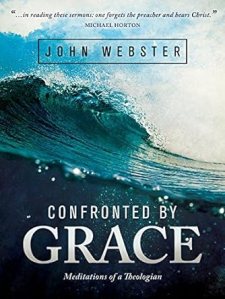
Confronted By Grace

By: John B. Webster

Making full use of his academic genius and renowned conversationalist skills, Webster skillfully presents deep doctrinal truths in a manner that quickly connects them with the readers heart. In the span of 247 pages, Webster provides his readers with manageable definitions of worship, anxiety, grace, faith, and many other topics that prove essential to the wellbeing of our souls. With his terms defined, the Anglican professor then thoughtfully applies the doctrines to his readers lives in the ensuing 4-5 paragraphs. In other words, Webster connects the Scriptures to his readers’ minds and emotions without devolving into the cheap sentimentality that has come to define so much of Christendom. As Michael Horton said of these short, doctrinal sermons, “One forgets the preacher and hears Christ.” Those who incorporate sermons into their devotional life or who are seeking to grow in their understanding of how to live out their Christian faith would greatly benefit from reading these sermons by the late John Webster. 

Excerpt:

Faith sees the truth about God and God’s merciful, gracious kingdom which is embodied for us in Jesus Christ. Faith is not just some crazy hope against evidence (indeed, when it becomes that it is itself a king of sickness). Quite the opposite: Faith is that deeply healthy state of the soul in which we let God be God. It’s that free, unhesitating, joyful assent to the one in the midst of whose kingdom we stand secure.

Devotion

By: Adam Makos

In the span of 445 up-tempo pages, Makos captures the essence of brotherly love against the backdrop of the Koren War. Though the movie that bears the same name as the book above portrays Jesse Brown as an angry black man, jaded by racism and Tom Hudson as a naive white man, lacking experience, the book teases out a much more complex, inspiring, and beautiful narrative. Though Jesse unquestionably encountered the brutalities of racism as children spat on him, teenagers assaulted him with eggs, and navy colleagues made unkind remarks, he was not an angry man on a mission, but rather a loving husband, father, and Christian, who longed to be home with his wife and daughter. Though much of the world was against Jessie, he easily inspired and won the friendship of men like Tom who shared the former sharecropper’s work ethic and love of neighbor. While on the ground attempting to save Jessie who had been shot down moments earlier, Tom said of his friend, “Jesse was so calm through it all, I’ve never seen anything like it…When we were on the ground, he was calming me down, when I should have been calming him down (393).” Tom, who almost never flew because of bouts with airsickness, also possessed remarkable fortitude. He stayed by Jessie’s side in the cold snow until his death and then stood with his wife and daughter in the years that followed. In a world of causes and movements, we would do well to spend more time reflecting on the bonds of friendship which can withstand even the strains of war. I fully agree with Makos that, “The world needs Jesse Brown and Tom Hudner, now more than ever.”

Excerpt

Against a backdrop of gray clouds, the two blue Corsairs dived toward the snowy mountains. Tom glanced at Jesse as their planes plummeted side by side. Jesse’s helmeted head scanned back and forth, his eyes searching for a place to crash. He was going down, seventeen miles northwest of Hagaru, deep inside enemy territory.

An Ark for All God’s Noahs

By: Thomas Brooks

Thomas Brooks’ 261-page volume serves as a spiritual b12 shot for believers who have been wounded and wearied by the world. Knowing that only a Christian’s unbelief could separate him from the glorious promises tied to the death and resurrection of Christ, Brooks wanted to help his readers get hold of their inheritance. He noted, “Nothing can make that man miserable that has God for his portion, nor nothing make that man happy who that wants God for his portion (xvii). In the first section, Brooks outlines, quantifies, and defines the nature of God’s promises, reminding the believer that God is the source of all goodness. The Puritan then explains why God freely bestows his goodness on those who believe before applying the doctrine to a host of practical concerns. He then ends the book answering objections that some of his readers had such as, could sin keep them from experiencing God’s promises. Though the book was first published in 1666, the promises of God that Brooks highlights remain forever relevant. And when Brooks makes use of a Latin phrase or even an awkward English expression, the Banner of Truth edition contains footnotes that quickly blow away any clouds of confusion that might otherwise disrupt the reading. If you want to be reminded afresh of just how amazingly good, loving, just, merciful, and patient our God is, I encourage you to read this book!

Excerpt:

If God be your portion, then every promise in the book of God is yours, and every attribute in the book of God is yours, and every privilege in the book of God is yours, and every comfort in the book of God is yours, and every blessing in the book of God is yours, every treasury in the book of God is yours, and every mercy in the book of God is yours, and every ordinance in the book of God is yours, and every sweet in the book of God is yours, if God be yours, all is yours.

Two Bonus Picks

Right Ho Jeeves by P.G. Wodehouse – “You know how it is with some girls. They seem to take the stuffing right out of you. I mean to say, there is something about their personality that paralyses the vocal cords and reduces the contents of the brain to cauliflower.

Expositions of Chapter 6: The New Man by Martyn Lloyd-Jones – “The cure for that [depression] is to realize that, whether you have sinned or not, you are in Christ; that sin does not affect you yourself as a person, that it cannot bring you again into its realm and reign; that sin only remains in your mortal body, and that – even that – because you are in Christ is going to be entirely set free.”

Lloyd-Jones, Cultural Problems, and the Power of the Gospel

The following article was published on the Credo Magazine Blog. If you have not visited the Credo website or listened to their podcast, I encourage you explore both!

The explosion of the German V1 rocket shook the spine of the historic Westminster Chapel, jolting the congregation to its feet. Seconds earlier, the rumble of the rocket’s engine had forced the pastor, David Martyn Lloyd-Jones, to pause his prayer. But as the plaster dust from the ceiling settled on top of his pulpit and black robe, Lloyd-Jones returned to his conversation with God.

At its conclusion, he allowed Mrs. Marsh to dust off both his robe and the pulpit. He also encouraged those perturbed by the blast to sit underneath the gallery for protection. He then proceeded on with the service with no more regard for the rockets. This brief picture of the Doctor’s preaching ministry encapsulated the Welsh Pastor’s understanding of how ministers should relate to the world of politics and culture. Lloyd-Jones believed God had commissioned pastors within the context of the local church to preach the gospel. It alone could cure sin and deliver men and women from the fear of death.

The Difference Between Sin and Sins

Throughout his career, Lloyd-Jones faced calls to address the political and social concerns of his day which encompassed everything from birth control to nuclear warfare. Though he carried around many firm political opinions within the folds of his black suits, he resolutely refused to share his political perspective on Sunday because he thought the fundamental problem facing humanity was ‘sin’ and not ‘sins.’

Though he carried around many firm political opinions, he resolutely refused to share his political perspective on Sunday because he thought the fundamental problem facing humanity was ‘sin’ and not ‘sins.’

The Doctor understood the term “sin” to encompass the effects of the fall, men and women’s separation from God and the ensuing pollution of their souls. Though restrained somewhat by God’s common grace, unredeemed men and women walked about the world in spiritual ignorance, lacking the ability to understand God and to do good. Because of the fall, men and women committed ‘sins,’ particular expressions of evil in time and space.

In the Doctor’s mind, political and social institutions such as the U.N, the English Parliament, and the trade unions dealt with sins as they sought to end wars, pass just laws, and advocate for fair wages. Though such endeavors were not inherently bad and deserved the support of individual Christians, the Doctor believed they would always prove inadequate. They treated only the symptoms of the sin and not sin itself. Despite the efforts of the philosophers and the politicians, sin remained fully entrenched in the human heart, pumping out sins that would continue to wreck both the individual and the institutions he or she occupied. To make matters worse, the Devil also avidly stirred humans towards sins and blinded them to truth. Humanity faced a spiritual pandemic it could not cure.

The Doctor concluded, “If any man could have saved us, the incarnation would not have taken place.”

Sin’s Antidote: The Gospel of Jesus

To save the world from sins, pastors had to move past sins and deal with the root problem, sin. Thankfully, God had designed the Church to proclaim the gospel specifically for this purpose. The Doctor noted:

That is the business of the gospel, not to be spending its time in treating the symptoms but to tell the world about the one and only remedy that can cure the disease which is the cause of all our local and particular problems.

When men and women responded to the good news of salvation, they gained liberation from sin and could overcome the sins in their hearts through the power of the gospel. The Doctor regularly witnessed transformation as he preached the Word. Drunks abandoned their liquor bottles, young widows found comfort in the midst of tears, and discouraged pastors found the hope needed to reascend their pulpit stairs. Lloyd-Jones believed such responses were normal because every human event from the death of Winston Churchill to the Cold War could be explained through the Bible’s redemptive narrative that chronicled the creation, fall, redemption, and new creation of humanity. By the power of the Holy Spirit, the “unique message of the Church,” transformed the human heart which could in-turn transform political and social institutions.

To change the world, pastors did not have to march in protests or speak at political rallies. In fact, the Doctor disliked the “pastor politician.” Lloyd-Jones believed the pastor politician’s constant denunciation of communism and other groups resulted in the “shutting of the evangelistic door upon that section.” Rather to improve the world, pastors needed only to walk in the footsteps of Jesus and the apostles and preach the gospel. The Word of God changed lives.

A Word of Caution

Despite the efforts of the philosophers and the politicians, sin remained fully entrenched in the human heart, pumping out sins that would continue to wreck both the individual and the institutions he or she occupied.

But even at this juncture, the Doctor’s optimism remained muted. Though he believed in, advocated for, and dreamed of revival, the Welsh pastor did not believe any pastor, denomination, or revivalist could usher in an era of perfect social harmony or world peace. Lloyd-Jones believed humanity would devolve until Christ returned. He wrote, “The Apocalypse alone can cure the world’s ills.” For this reason, even the inspiring movements of faith that came out of the First and Second Great Awakenings proved fleeting. The local church could not Christianize the world. The recreation of the world was the special purview of Jesus.

Until Christ returned to judge the living and the dead, the world would continue to know of divorce, wars, and every other social ill. Christians could expect to be marginalized and to experience persecution. But even in this world of gloom, Christians did not have to fear their neighbors, society, political institutions, or anything else under heaven. Their salvation and eternal destiny remained secure. The Doctor said,

Let your hurricanes come one after the other, and all together it will make no difference. Let men set off all their bombs in the whole universe at the same time, this inheritance remains solid, durable, everlasting, eternal.

Though tomorrow might fail the Christian, eternity would far surpass the believer’s expectations.

Conclusion

Prudence demands that historians, pastors, and the average reader should not attempt to insert Lloyd-Jones into twenty-first century discussions about the Black Lives Matter movement, the Coronavirus pandemic, or the storming of the U.S. Capital by rioters. We have no special insights into what the Doctor would have thought about such things.

But of this we can be sure. The man who preached Christ while bombs fell out of the sky would never abandon the gospel and devote his pulpit to the advancement of social causes. The Scriptures spoke to the needs of every age. As the Doctor noted, the gospel, “alone deals with our fundamental need.” Jesus saves.