
A Brief History of Martin Luther: The Monk Who Changed the World

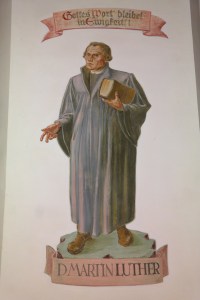
Martin-Luther-ReformatinoOn October 31, 1517, Martin Luther set off an earth quake that would reorder Christendom with a few taps of a hammer and with a postage stamp. Luther did not believe that his 95 thesis which first appeared on the door of the Wittenberg Chapel and that were mailed to Cardinal Albrecht of Mainz were controversial. Rather he saw his document as reforming abuses of Catholic doctrine. A few months earlier while delivering his Disputation Against Scholastic Theology, Luther had said,
We do not become righteous by doing righteous deeds but, having been made righteous, we do righteous deeds. This in opposition to the philosophers.

Luther had knowingly criticized core church doctrines as evidence by his phrase “in opposition to the philosophers”, but he still believed he was in full “agreement with the Catholic church and the teachers of the church.” He saw himself as recovering the historic Catholic Faith. No one in the Catholic church which held to salvation by grace and works blinked. Quite naturally, Luther believed he had to freedom keep criticizing the abuses within the Catholic Church.

In 1517, Luther indirectly encountered a larger-than-life abuser of Catholic doctrine in the person of Johann Tetzel who was a Dominican Friar entrusted with the sale of indulgences. The indulgence was a little piece of paper that absolved Christians from their venial sins.

The Christian would confess their sins to the priest. While God’s grace covered the sin’s guilt, the sin’s punishment became the domain of the priest upon confession. The priest was then responsible for forgiving the punishment of the Christian’s sin. To show that he or she was worthy of the priest’s forgiveness, the believer would do good works, such as saying prayers, taking pilgrimages, and kissing of artifacts. And if a man or woman could not pay for all their sins in this life, they would be sent to purgatory, an eternal place above hell and below heaven where  sinners still stained by sin paid off their remaining sin debt in preparation of heaven. But if the Christian bought the indulgence the penalty of their sin was covered by the Popes excess grace. God had given the Pope more grace than the Pope needed. Thus, the Pope happily shared it with poor, common sinners for a price. As Tetzel said, “When a coin in the coffer rings, a soul from purgatory springs.”  Half the proceeds went to Rome to build St. Peter’s Cathedral and half went to the Bishop of Mainz.

Though Luther never directly encountered Tetzel because the indulgences peddler was prohibited from entering Duke Ferdinand’s territory, Luther’s congregants were able to travel to Tetzel’s salvation market. They returned with troubling stories. He reported the following to Cardinal Albrecht,

Evidently the poor souls believe that when they have bought indulgence letters they are then assured of their salvation. They are likewise convinced that souls escape purgatory as soon as they have placed a contribution into the chest.

Luther could not help but respond. And so, he wrote the 95 Theses. The five theses below capture thrust of his concerns and beliefs:

  1. Any truly repentant Christian has a right to full remission of penalty and guilt, even without indulgence letters.

  2. Christians are to be taught that if the pope knew of the exact actions of the indulgence preachers, he would rather that the basilica of St. Peter were burned to ashes than built up with the skin, flesh, and bones of his sheep.

  3. The true treasure of the church is the most holy gospel of the glory and grace of God.

  4. Christians should be exhorted to be diligent in following Christ, their head, through penalties, death, and hell.

  5. And thus be confident of entering into heaven through many tribulations rather than through the false security of peace [Acts 14:22].

Though Luther began the debate of indulgences within the walls of the university and the church, the subject of salvation was also on Luther’s mind.

martin-luther-232081_1920On July 17, 1505, Luther entered the Augustinian Monastery in Erfurt much to his father’s dismay. Luther had been destined for a career in Law. But on July 2, 1505, he had been caught in a severe thunderstorm. As thundered boomed overhead and as lightening flashed about him, Luther promised St. Anne that he would take monastic vows and devote his life to the church if he survived. Luther made it out alive. And so, he began serving the Catholic Church, happily embracing her doctrine of salvation by grace and works. Luther noted in 1545 that

I was once a monk and a most enthusiastic papist when I began that cause.

Luther sought salvation through an excruciation mean such as sleeping on the ground and whipping himself. He did so because the Catholic church taught that God only awarded grace to those who demonstrated a propensity for holy living, in the same way some would demonstrate a propensity for baseball, or metal working, or organization.

Luther sought to earn God’s grace which would then justify him and cover his sin debt. But as Luther become a priest and then a doctor of theology, he found himself constantly failing God. Yes, he worked hard. He would confess sins for hours, study for days, and fast for weeks. Yet, he was never able to be holy enough for God. Luther commented,

Though I lived as a monk without reproach, I felt that I was a sinner before God with an extremely disturbed conscience. I could not believe that he was placated by my satisfaction. I did not love, yes, I hated the righteousness of God who punishes sinners…I was angry with God.

Luther knew he was not holy. He knew God was infinitely holy. And he knew that this holy God called Luther to be Holy. Luther felt like the 4’ kid on the basketball court who is commanded to dunk on the 10’ rim. God was asking him to do the impossible.

Then by God’s grace, Luther read Romans 1:17:

For in it the righteousness of God is revealed from faith for faith, as it is written, “The righteous shall live by faith.

By God’s grace Luther realized salvation was not earned it was given.  Luther recounted the moment as a follows:

There I began to understand that the righteousness of God is that by which the righteous lives by a gift of God, namely by faith. And this is the meaning: the righteousness of God is revealed by the gospel, namely, the passive righteousness with which the merciful God justifies us by faith.

As Luther later summarized in his Heidelberg Disputation ,

The Law says, “do this,” and it is never done. Grace says, “believe in this’” and everything is done already.

Thus, Luther wrote the 95 Theses convinced that salvation comes through grace alone by faith alone apart from the works of the Law and the deeds of the church. Luther wrote his Theses thinking his position was the position of the silent majority position over the church. He was about to be rudely awakened.

When Cardinal Albrecht read the 95 Theses and Luther’s Sermon on indulgences, the Cardinal quickly forwarded Luther’s writings onto the Pope Leo X. The upstart monk was criticizing an important source of income, was denying Papal authority, and was challenging the doctrine of salvation. Albrecht believed Luther needed to be stopped before he harmed the church.

Because the Pope wished to have Charles V elected as the next Holy Roman Emperor, he needed Duke Ferdinand’s support. Thus, Luther was examined by the papal legate Catejan at the Diet of Ausburg instead of being called to Rome. Luther was told to recant twice and refused both times, irritating Catejen.

In 1519, Luther ordered to attend the Leipzig Disputation. He  entered  into two week debate with Johann Eck and others. Towards the end of the debate, Eck labels Luther a Hussite. The Hussites were named for their founder Jon Huss who had been burned at the stake in 1415 for teaching the Popes could err.

Huss had boldly said,

Thus the Pope is not the head nor are the cardinals the entire body of the holy, Catholic, and universal Church. For Christ alone is the head of the Church and all predestined together form the body, and each alone is a member of that body, because the bride of Christ is united with him.

Unfamiliar with Huss, Luther asked and received a recess to study the works of Huss. When Luther returned to the debate, Luther boldly declared that he stood with Huss and his teachings! Luther boldly said,

The truth of the Scriptures comes first. After that is accepted one may determine whether the words of men can be accepted.

Eck had forced Luther to admit his disdain for papal authority. With a clear understanding of Luther’s theology, Pope Leo X issued a papal bull officially commanding Luther to recant on June 15, 1520. Luther responded by burning the Pope’s order.

The church was ready to arrest the troublesome monk, but Luther tossed the church a curveball asking for a secular trial. Seeking to promote political unity, the Emperor Charles V created the Diet of Worms in April 1521. When Luther appeared before the council, the council ordered Luther to recant once again. Luther asked for a day to think over his answer. When Luther returned the following day, he delivered his now famously response.

 Unless I am convinced by the testimony of the Scriptures or by clear reason (for I do not trust either in the pope or in councils alone, since it is well known that they have often erred and contradicted themselves), I am bound by the Scriptures I have quoted and my conscience is captive to the Word of God. I cannot and will not recant anything, since it is neither safe nor right to go against conscience. May God help me. Amen

All hopes of quieting the disgruntled German pig were dashed. Luther was condemned by the Catholic Church. And Luther condemned the Catholic Church for teaching a false gospel. The earthquake started on October 31, 1517 had now become fisher of continental proportions.

On May 26, 1521 the Charles V issued the Edict of Worms. Both the church and the state had now condemned Luther to be a a heretic . Charles V commanded his subjects to: “seize him and overpower him, you should capture him and send him to us under the tightest security.”

Understanding the gravity of Luther’s situation, the friendly Duke Ferdinand arranged for Luther to be kidnapped and taken safely to Wartburg Castle. While living in the castle, Luther would translated the Bible into German. Once the political climate died down, Luther came out of hiding and began to advocate for reformation theology, writing numerous books and catechism, and addressing societal concerns. In 1527, he married the former nun Katharina Von Bora. Together they had six children. Two of the children died in childhood. Luther spent the reminder of his life, preaching, teaching, and discipling men and women in faith. He died on Feb 18, 1546 at the age of 63. Though Luther has long been removed from the theological scene, his influence lives on today because he recovered the gospel once deliver for all! As Luther said of himself:

“I simply taught, preached, wrote God’s Word; otherwise I did nothing. And then while I slept, or drank Wittenberg beer… the Word so greatly weakened the papacy that never a prince or emperor did so much damage to it. I did nothing. The Word did it all.”

The Precedented Unprecedented

precedentThe interdisciplinary team working at Huanchaquito-Las Llamas recently disturbed the modern conscience with their latest discovery. The team led by Gabriel Prieto of the Universidad Nacional de Trujillo and John Verano of Tulane University and sponsored by the National Geographic revealed that their Peruvian archaeological dig contained the, “largest single incident of mass child sacrifice in the Americas— and likely in world history.” The scientists and historians found the remains of more than 140 children and 200 baby lamas that had been murdered and mutilated some 550 years ago by the Chimú Empire. And less than a half mile away from where children’s hearts were ripped from their chests, the empire conducted their affairs of state. Calculated trades and negotiations took place just minutes away from unbelievable horror.
The pictures of the excavated skeletons lying face up with broken ribs are dark and disturbing. Though America is increasingly defined by violence, the mass premeditated murder of 140 or more children still disturbs the modern mind as evidenced by the magazine’s bold claims. And evil of this magnitude should be noted in the press and mourned.
But the Kristin Romey, one of National Geographic’s editors that covers archaeology and paleontology, missteps when she attempts to help audience appreciate the magnitude of the slaughter being studied. She writes,

The discovery of a large-scale child sacrifice event in the little-known pre-Columbian Chimú civilization is unprecedented in the Americas—if not in the entire world.

Romey’s captures the sentiment of the moment, but she wrong assumes that the sacrifice is unprecedented in world history.
In one sense, her claim is justifiable. The whole sale slaughter of 140 plus children at one religious event is noteworthy. But when compared against the annals of world history, academics cannot say this is unprecedented. If we go back only four years in the historical cannon of world history, we discover a far greater slaughter.
In 2014, the United States legally aborted 652,639 children (the most recent statistical year in file) according to the CDC. Americans aborted more than 1,788 babies per day in 2014 down. Such acts of horror took place down the street from hospitals, gas stations,  factories, restaurants, and government buildings. Clearly large scale infanticide taking place in close proximity to a nation’s established societal institutions  is not unprecedented in the Americas as Romey claimed.
Admittedly some will object to the comparison, pointing to the religious nature of pre-Columbian event. Few if any abort a child to appease the gods or to convince them to send rain. Few if any cut out the heart of their child to determine their future or to connect with the life force of the gods.
But the basic ideas that drove those men and women to murder children 550 years ago are still driving modern men and women today.
The Chimú people sacrificed those 140 plus children because they believed their deaths would benefit society by alleviating hardship and winning more wealth and happiness. Today, boyfriends and husbands, parents, and ultimately mothers abort their children for their benefit. They do not want to be saddled with having to care for the child’s physical, emotional, and monitory needs. Modern adults do not want to sacrifice their educational goals, their financial plans, and their personal peace for a child. Instead of sacrificing for the child, they sacrifice the child for their needs. As C.S. Lewis thoughtfully showed through his book, That Hideous Strength, modern science divorced from Christian morality often becomes  little more than cruelly efficient paganism. The Chimú people could kill 140 or more kids in one day at one location. We can kill 1,788 or more kids across 50 states in a day. We too rip apart the bodies of our dead children seeking to find brighter futures filled with medical advancements. For all of our advancements modern men and women apart from Christ are still quintessentially pagan.
As believers we should mourn the discovery at Huanchaquito-Las Llamas. But we must not leave our gaze in the past. We must fight against our nation’s annual sacrifice of children to the gods of ease, comfort, and wealth. We must support foster care and adoption. We must speak for the unborn. We must engage in the political community. We must do all that we can to end this slaughter.
We do not find fault God for bringing the Chimú government to end. If this is true, can we find fault with God for one day bringing our nation to an end?
God be merciful to us!

Your Church Discipleship Isn’t Working

discipleshipDiscipleship. Seemingly every Southern Baptist Pastor and every evangelical minister, lay leader, and church member worthy their salt is all about this word. Discipleship books are popping of the selves of Christian books stores, conferences are dominated by the theme, and most every Sunday school vendor has launched some sort of new “Discipleship” curriculum that synthesizes discipleship principles into an accessible five to seven step program that promises to redefine you and your church.

The focus upon discipleship is extremely timely and needed. Today, only 1 of every three Southern Baptists attends church on Sunday. And only 39% of SBC members read their Bible every day. Mega churches such as Willow Church have and are continuing to radically adjust their programming because they discovered church participation does not equal spiritual growth and abiding faith. As Bill Hybles notes, “We made a mistake. What we should have done when people crossed the line of faith and become Christians, we should have started telling people and teaching people that they have to take responsibility to become self-feeders.” As a result of this mistake and of many others, SBC and evangelical churches often resembles the American culture which prizes self-actualization above all else. As Americans and Christians look within they do not find peace. They find narcissism. New York Times Columnist Ross Douthat comments that,

A nation of narcissist turn out to be a nation of gamblers speculators, gluttons, and gym obsessives, pornographers and Ponzi schemers, in which household debt rises alongside public debt, and bankers and pensioners and automakers and unions all compete to empty the public trough.

The same can often be said of Christendom. The evangelical, conservative church desperately needs revival and reformation. She can greatly benefit from rediscovering discipleship.

The focus upon discipleship is also needed because Jesus commands his followers to make disciples. In Matthew 28:19-20 Jesus commands us to:

“Go therefore and make disciples of all nations, baptizing them in[b] the name of the Father and of the Son and of the Holy Spirit, teaching them to observe all that I have commanded you. And behold, I am with you always, to the end of the age.”

Christians are to make disciples. Christians are to be regularly teaching each other, investing in the lives of others, and sharing their faith. All who follow Christ have been commissioned by their God to make disciples. All Christians should be about the business of being discipled and discipling.

The church should champion discipleship. I am thankful for Bill Hull, Robby Gallaty, and the many others who have speared headed the discipleship movement. But in their zeal to disciple, the created a defective view of discipleship. Gallaty defines discipleship as, “intentionally equipping believers with the Word of God through accountable relationships empowered by the Holy Spirit in order to replicate faithful followers of Christ.”

The definition is good as far as it goes. It rightly priorities the relational nature of the Christian faith. But Gallaty’s and many others stop short of the historical definition of discipleship taught in the Scriptures and defended by Southern Baptists of old. The leaders of the modern discipleship movement divorce discipleship from the historical doctrines of formative and corrective discipline, making discipleship the property of the small group instead of the church. To teach God’s people the full counsel of God, the people of God have to deal with ecclesiology. They have to teach on and exercise the keys of the kingdom. The small group is the only one of many important cogs used by God to mature men and women into his image.

alex-gorham-341310-unsplashUntil liberalism stormed into the SBC in the late 19th and early 20th century, Baptist theologians seldom employed the word discipleship. The used the word discipline from which the English word discipleship derives. They believed two types of discipline existed: Formative Discipline and Corrective Discipline. As one might guess, formative discipline consisted of all the disciplines needed to mature or form the believer in the faith. Baptists affirm that the church forms disciples through covenants, the preaching of the Word, and small groups. Instead of being the impetus for discipleship, small groups are places where church members are encouraged to live out their covenantal commitments in light of their pastors’ teaching. Small group foster and aid the general discipleship process of the church but are not the discipleship process.  Mark Dever rightfully notes, the pastor’s “teaching of the Word is the core of the church’s discipleship ministry.” And the great German theologian Dietrich Bonhoeffer concurs, writing that “the sermon remains the encompassing of spiritual care.”

As men faithfully expound the Scriptures detailing all the commands of Scripture, men and women hear truth, internalize truth, and then begin to make decisions based on the truth. Dr. D.Martin Lloyd-Jones notes that the goal of preaching is “to isolate the radical problems and to deal with them in a radical manner.” Preaching is discipleship. Church covenants are discipleship. Small groups are discipleship. And every element of church worship and life that proclaims the gospel is discipleship from the pulpit to the arm chair. In short, formative discipline is the process of forming believers into disciples through the accurate and intentional teaching of biblical truth. As the great Baptist theologian Edward T. Hiscox writes,

[edification and spiritual growth] are largely attained by instruction from the pulpit, the various departments of worship and the general activities of the Christian life.

Churches that have poor discipleship programs most likely do not have a faulty small group structure. They have a faulty preacher.

Discipleship, formative discipline, begins and ends with the local church.

Admittedly, even the most faithful of local churches will not produce perfect disciples. Though church covenants, godly preaching, and small groups should do much to promote the spiritual growth in the church, men and women are still very much sinners who are prone to sin. Matthew 18 clearly teaches the local church to be prepared for such failures. Men and women are commanded to confront those who sin and to call them to repentance. Most of the time such confrontations end well and the sinner believer is restored. But at times, the believer refuses to repent, the Christians must go back to the sinner with witnesses. And if that does not work, the believer must take the matter to the church. And if the sinner still refuses to repent, the sinner must be put out of the church.

Corrective church discipline described above can be likened to a school grade. Jonathan Leeman notes that the church should award A’s to those who diligently pursue Christ and to those who willingly repent of their sins, but hands out F’s to those who refuse to obey Jesus’ commands. If the church refuses to issue letter grades and if the church refuses to discipline men and women for unrepentant sins, the discipleship culture of the church will unravel. Anarchy will reign because obeying self is always easier than obeying Jesus. Hiscox prophetically notes,

The Church is the school of Christ; let the school be controlled with strict, yet wise and kindly discipline or the pupils will learn more of evil than of good, and anarchy and confusion will supplant good government.

Sadly a quick scan of today’s churches validate Hiscox’s warning. They are weak, feeble, wandering, sick, and lead by ungodly men and women because they have abandon elements of if not the entire doctrines of formative and corrective discipline. J.L. Dagg also hit the nail on the head in in 1858 when he wrote, “When discipline leaves the church, Christ goes with it.”

The discipleship programs in most of our conservative churches are broken because they follow Gallaty and Hull and others and only embrace one of the elements formative discipline, neglecting preaching and covenants and completely ignoring all the meaningfully elements of corrective discipline.

Brothers and sisters we do not need more small groups. We need men and women who are committed to the whole counsel of God and who are committed to preaching and living the Word, willing embracing all the costs and heart aches of church discipline. Until the churches of the SBC and conservative evangelicals begin lovingly and thoughtfully practicing church discipline, there will be no revival in America. I share Dr. Albert Mohler’s conclusion that,  “A church lacking these essential qualities, is biblically defined, not a true church.”

Are you ready to embrace both formative and corrective church discipline?