
The Girl Scouts Sue The Boy Scouts For Being Too Inclusive: A Christian Response

scoutsThe Girl Scouts of the USA have sued the Boy Scouts of America for reaching out to girls. While the Girl Scouts have applauded inclusion within their own ranks warmly embracing both homosexuals and transgender members, the group has found the Boy Scouts latest steps towards inclusivity to be profoundly troubling.

No one else on the cultural left including the Girl Scouts sued nor even threaten to sue the Boy Scouts when the Boy Scouts began their march to diversity. The Boy Scouts welcomed openly gay members in 2013, embraced gay scout leaders in 2015, and invited transgender boys to join in 2017 with support of the cultural left. In 2018, the Boy Scouts accelerated their march up the mountain of diversity by declaring that their historic organization would change its name from Boy Scouts to Scouts BSA. The name change accompanies the Scout‘s plan to begin awarding the rank of Eagle Scout to both boys and girls starting in 2019. The organisation hopes, “to offer families the options they want.” Zach Wahls the co-founder of Scouts for Equality and an Eagle Scout in his own right hailed the announcement as “yet another step forward” for the Boy Scouts which signals that the “future is bright for Scouting in America.”

But Girl Scouts have strongly object to the Boy Scouts plan, believing the name change marginalizes women.

Why do the Girl Scouts have such a negative view of the Boy Scouts’ affirmation of girl empowerment?

The Girls Scouts find the Boy Scout’s announcement offensive because it denies the beauty of femininity. Girl Scouts exists upon the presumption that girls are different than boys. According to the Girl Scouts, “only Girl Scouts has the expertise to give girls and young women the tools they need for success.” Kate Taylor from Business Insider noted,

“However, positioning girls joining the Boy Scouts as the ultimate triumph for feminist scouting does a massive disservice to girls. There is an opportunity to applaud an organization that centers itself around girls and women, instead of assuming that a male-centric organization is implicitly preferable.”

These statements combat the notion that men and male driven cultures should dominate feminine ideas and life. But these mild expressions of feminism make are founded upon the presumptions that men and women are biologically different, and that women should be celebrated for diverging from masculine norms.

However, the historical and biological definition of gender that shaped the Girl Scouts has been abandoned by America’s cultural elite with the arrival of the homosexual movement and the transgender movement. Today, those who feel they are male are deemed by society to be male regardless of their birth-certificate; and those who identify as female are proclaimed to be female regardless of their chromosome makeup. If gender can be changed as quickly as one changes a t-shirt, gender becomes a meaningless distinction. He who was a boy today could be a girl tomorrow. Since gender is a social construct created apart nature, the terms ‘boy’ and ‘girl’ can be reduced to obsolete expressions from archaic cultures that no longer shape modern thought. Consequently, the need for cultural institutions that serve just boys or just girls disappears. Children and adults simply are. They don’t need Boy Scouts and Girl Scouts; they just need Scouts.

The conflict between the Girl Scouts and the Boy Scouts is much bigger than scouting. It reveals the limits of the sexual revolution. The revolution cannot both deny biological gender and meaningfully affirm the beauty and strength of femininity (or masculinity for that matter). Either girls exist in nature and benefit from groups like Girl Scout, or girls don’t exist in nature and don’t need their own groups. How you answer the gender question will determine whether or not you applaud or deride the Boy Scouts for extending the olive branch to girls.

The Christian Response

Thankfully, Christians have no such dilemma. We can affirm science and happily proclaim that two gender exists. God created us male and female. Boys and girls come into the world as boy and girls. Jesus affirmed that marriage was between a man and a woman (Matt 19:3-6). The Bible does not abolish the two genders. It affirms the existence of biological men and women.

And gender is not a matter of power. According to the Scriptures both men and women are created in the image of God. Both equally picture the divine creator. Yet the genders are distinct. The male and female sexual anatomy have several irreconcilable and enjoyable differences. Men and women have different strengths and abilities. Yet, men and women thrive in unity. They thrive in marriage where the strengths of the man complement the woman and where the strengths of the woman complement the man. Marriage is beautiful because it unites men and women by celebrating their complementary differences.

Christians can and should celebrate the difference between men and women. We have plenty of room to have gender-based organizations within Christendom. Christians deny the idea that girls have to be boys or do boy things to thrive in society. But they arrive at this conclusion by affirming the existence of biological gender. If biological gender exists, then girls do not need to be Boy Scouts and boys do not need to be in Girl Scouts even if they feel more feminine than male. Christians have an answer to the Scouting dilemma. The secular elites do not.

Because we have answers to these difficult questions, we should lovingly share them. We should not retreat from the world fearing what people will think or fearing that talking to the gay couple at McDonald’s will make us icky. We have truth. We have the loving truth that Jesus Christ has died to save sinners which guides all of life.. And we should share the truth with our hurting world. Dr. Albert Mohler rightful notes,

America’s post-Christian culture is filled with people who believe that they have heard too much from the Christian church – too much judgment, too much moralism, too much intolerance. The New Testament, however, tell us that the world around us has seen and heard far too little authentic Christianity.

We truly have something amazing to offer a culture that struggles to determine if girls should be allowed to join Boy Scouts. Shouldn’t we be desire to loving converse with our confused world?

A Brief History of Martin Luther: The Monk Who Changed the World

Martin-Luther-ReformatinoOn October 31, 1517, Martin Luther set off an earth quake that would reorder Christendom with a few taps of a hammer and with a postage stamp. Luther did not believe that his 95 thesis which first appeared on the door of the Wittenberg Chapel and that were mailed to Cardinal Albrecht of Mainz were controversial. Rather he saw his document as reforming abuses of Catholic doctrine. A few months earlier while delivering his Disputation Against Scholastic Theology, Luther had said,
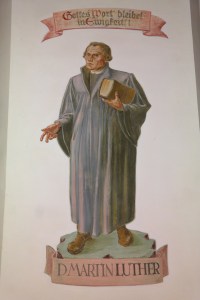
We do not become righteous by doing righteous deeds but, having been made righteous, we do righteous deeds. This in opposition to the philosophers.

Luther had knowingly criticized core church doctrines as evidence by his phrase “in opposition to the philosophers”, but he still believed he was in full “agreement with the Catholic church and the teachers of the church.” He saw himself as recovering the historic Catholic Faith. No one in the Catholic church which held to salvation by grace and works blinked. Quite naturally, Luther believed he had to freedom keep criticizing the abuses within the Catholic Church.

In 1517, Luther indirectly encountered a larger-than-life abuser of Catholic doctrine in the person of Johann Tetzel who was a Dominican Friar entrusted with the sale of indulgences. The indulgence was a little piece of paper that absolved Christians from their venial sins.

The Christian would confess their sins to the priest. While God’s grace covered the sin’s guilt, the sin’s punishment became the domain of the priest upon confession. The priest was then responsible for forgiving the punishment of the Christian’s sin. To show that he or she was worthy of the priest’s forgiveness, the believer would do good works, such as saying prayers, taking pilgrimages, and kissing of artifacts. And if a man or woman could not pay for all their sins in this life, they would be sent to purgatory, an eternal place above hell and below heaven where  sinners still stained by sin paid off their remaining sin debt in preparation of heaven. But if the Christian bought the indulgence the penalty of their sin was covered by the Popes excess grace. God had given the Pope more grace than the Pope needed. Thus, the Pope happily shared it with poor, common sinners for a price. As Tetzel said, “When a coin in the coffer rings, a soul from purgatory springs.”  Half the proceeds went to Rome to build St. Peter’s Cathedral and half went to the Bishop of Mainz.

Though Luther never directly encountered Tetzel because the indulgences peddler was prohibited from entering Duke Ferdinand’s territory, Luther’s congregants were able to travel to Tetzel’s salvation market. They returned with troubling stories. He reported the following to Cardinal Albrecht,

Evidently the poor souls believe that when they have bought indulgence letters they are then assured of their salvation. They are likewise convinced that souls escape purgatory as soon as they have placed a contribution into the chest.

Luther could not help but respond. And so, he wrote the 95 Theses. The five theses below capture thrust of his concerns and beliefs:

  1. Any truly repentant Christian has a right to full remission of penalty and guilt, even without indulgence letters.

  2. Christians are to be taught that if the pope knew of the exact actions of the indulgence preachers, he would rather that the basilica of St. Peter were burned to ashes than built up with the skin, flesh, and bones of his sheep.

  3. The true treasure of the church is the most holy gospel of the glory and grace of God.

  4. Christians should be exhorted to be diligent in following Christ, their head, through penalties, death, and hell.

  5. And thus be confident of entering into heaven through many tribulations rather than through the false security of peace [Acts 14:22].

Though Luther began the debate of indulgences within the walls of the university and the church, the subject of salvation was also on Luther’s mind.

martin-luther-232081_1920On July 17, 1505, Luther entered the Augustinian Monastery in Erfurt much to his father’s dismay. Luther had been destined for a career in Law. But on July 2, 1505, he had been caught in a severe thunderstorm. As thundered boomed overhead and as lightening flashed about him, Luther promised St. Anne that he would take monastic vows and devote his life to the church if he survived. Luther made it out alive. And so, he began serving the Catholic Church, happily embracing her doctrine of salvation by grace and works. Luther noted in 1545 that

I was once a monk and a most enthusiastic papist when I began that cause.

Luther sought salvation through an excruciation mean such as sleeping on the ground and whipping himself. He did so because the Catholic church taught that God only awarded grace to those who demonstrated a propensity for holy living, in the same way some would demonstrate a propensity for baseball, or metal working, or organization.

Luther sought to earn God’s grace which would then justify him and cover his sin debt. But as Luther become a priest and then a doctor of theology, he found himself constantly failing God. Yes, he worked hard. He would confess sins for hours, study for days, and fast for weeks. Yet, he was never able to be holy enough for God. Luther commented,

Though I lived as a monk without reproach, I felt that I was a sinner before God with an extremely disturbed conscience. I could not believe that he was placated by my satisfaction. I did not love, yes, I hated the righteousness of God who punishes sinners…I was angry with God.

Luther knew he was not holy. He knew God was infinitely holy. And he knew that this holy God called Luther to be Holy. Luther felt like the 4’ kid on the basketball court who is commanded to dunk on the 10’ rim. God was asking him to do the impossible.

Then by God’s grace, Luther read Romans 1:17:

For in it the righteousness of God is revealed from faith for faith, as it is written, “The righteous shall live by faith.

By God’s grace Luther realized salvation was not earned it was given.  Luther recounted the moment as a follows:

There I began to understand that the righteousness of God is that by which the righteous lives by a gift of God, namely by faith. And this is the meaning: the righteousness of God is revealed by the gospel, namely, the passive righteousness with which the merciful God justifies us by faith.

As Luther later summarized in his Heidelberg Disputation ,

The Law says, “do this,” and it is never done. Grace says, “believe in this’” and everything is done already.

Thus, Luther wrote the 95 Theses convinced that salvation comes through grace alone by faith alone apart from the works of the Law and the deeds of the church. Luther wrote his Theses thinking his position was the position of the silent majority position over the church. He was about to be rudely awakened.

When Cardinal Albrecht read the 95 Theses and Luther’s Sermon on indulgences, the Cardinal quickly forwarded Luther’s writings onto the Pope Leo X. The upstart monk was criticizing an important source of income, was denying Papal authority, and was challenging the doctrine of salvation. Albrecht believed Luther needed to be stopped before he harmed the church.

Because the Pope wished to have Charles V elected as the next Holy Roman Emperor, he needed Duke Ferdinand’s support. Thus, Luther was examined by the papal legate Catejan at the Diet of Ausburg instead of being called to Rome. Luther was told to recant twice and refused both times, irritating Catejen.

In 1519, Luther ordered to attend the Leipzig Disputation. He  entered  into two week debate with Johann Eck and others. Towards the end of the debate, Eck labels Luther a Hussite. The Hussites were named for their founder Jon Huss who had been burned at the stake in 1415 for teaching the Popes could err.

Huss had boldly said,

Thus the Pope is not the head nor are the cardinals the entire body of the holy, Catholic, and universal Church. For Christ alone is the head of the Church and all predestined together form the body, and each alone is a member of that body, because the bride of Christ is united with him.

Unfamiliar with Huss, Luther asked and received a recess to study the works of Huss. When Luther returned to the debate, Luther boldly declared that he stood with Huss and his teachings! Luther boldly said,

The truth of the Scriptures comes first. After that is accepted one may determine whether the words of men can be accepted.

Eck had forced Luther to admit his disdain for papal authority. With a clear understanding of Luther’s theology, Pope Leo X issued a papal bull officially commanding Luther to recant on June 15, 1520. Luther responded by burning the Pope’s order.

The church was ready to arrest the troublesome monk, but Luther tossed the church a curveball asking for a secular trial. Seeking to promote political unity, the Emperor Charles V created the Diet of Worms in April 1521. When Luther appeared before the council, the council ordered Luther to recant once again. Luther asked for a day to think over his answer. When Luther returned the following day, he delivered his now famously response.

 Unless I am convinced by the testimony of the Scriptures or by clear reason (for I do not trust either in the pope or in councils alone, since it is well known that they have often erred and contradicted themselves), I am bound by the Scriptures I have quoted and my conscience is captive to the Word of God. I cannot and will not recant anything, since it is neither safe nor right to go against conscience. May God help me. Amen

All hopes of quieting the disgruntled German pig were dashed. Luther was condemned by the Catholic Church. And Luther condemned the Catholic Church for teaching a false gospel. The earthquake started on October 31, 1517 had now become fisher of continental proportions.

On May 26, 1521 the Charles V issued the Edict of Worms. Both the church and the state had now condemned Luther to be a a heretic . Charles V commanded his subjects to: “seize him and overpower him, you should capture him and send him to us under the tightest security.”

Understanding the gravity of Luther’s situation, the friendly Duke Ferdinand arranged for Luther to be kidnapped and taken safely to Wartburg Castle. While living in the castle, Luther would translated the Bible into German. Once the political climate died down, Luther came out of hiding and began to advocate for reformation theology, writing numerous books and catechism, and addressing societal concerns. In 1527, he married the former nun Katharina Von Bora. Together they had six children. Two of the children died in childhood. Luther spent the reminder of his life, preaching, teaching, and discipling men and women in faith. He died on Feb 18, 1546 at the age of 63. Though Luther has long been removed from the theological scene, his influence lives on today because he recovered the gospel once deliver for all! As Luther said of himself:

“I simply taught, preached, wrote God’s Word; otherwise I did nothing. And then while I slept, or drank Wittenberg beer… the Word so greatly weakened the papacy that never a prince or emperor did so much damage to it. I did nothing. The Word did it all.”

Why Should Baptists Celebrate A German Monk’s Reformation?

Martin Luther accidentally drove a nail into heart of the Roman Catholic Church on October 31, 1517. The Augustine Monk, preacher, and theology professor posted his 95, seeking to restore the seldom heard gospel to her rightful position of prominence within the church.

What Did Luther Oppose?

The Catholic Church had replaced the gospel with the sacramental system. Rome’s theologians taught that God saved those who nobly sought after grace. God wiped away the stain of original sin at baptism. God then justified everyone who sought to please God by doing good works. After conversion, God required his children to pay for their sins through the sacraments of Mass and penance. The bread inoculated believers from the allure of sin. And penance proscribed by the priest would absolve believers from the punishment of their sins.

Recognizing that many Christians could not pay off their sin debt before death, the Catholic Church created the doctrine of purgatory, a place between heaven and hell where believers paid off their remaining sins through holy suffering.

By 1517, the church had also launched an aggressive campaign to sell indulgences, little pieces of paper that promised to absolve Christians from their sins and to spring those already deceased from purgatory. With the Pope’s blessing, believers could go past go and collect their $200 of religious merit by donating money toward the construction of St. Peter’s Cathedral.

luther-1821498_1920

Concerned with the Church’s doctrinal drift and also its moral decay, Martin Luther posted his 95 Theses on the door of the Wittenberg, seeking to bring it back to the gospel. Luther had tried the sacramental system and found it powerless to forgive sins.

Luther’s Story of Salvation

After entering monastic life because he made a rash promise in the middle of thunderstorm, Luther spent years attempting to earn his salvation. He prayed, fasted, slept on cold floors, and confessed sins for hours at a time. Reflecting on his time in the monastery Luther noted, “if ever a monk got into heaven through monasticism, I should have been that man.” Yet, Luther never experienced liberation from sin and death.

Then as Luther studied the Psalms and Romans, he came to realize that no one could be good enough to earn salvation. As Psalm 51:2-3 said,

God looks down from heaven on the children of man to see  if there are any who understand, who seek after God. They have all fallen away; together they have become corrupt; there is none who does good, not even one.

God demanded perfect obedience, yet people could not be perfect. This knowledge of God’s commands and of his inability to meet those demand drove Luther to anger. Luther said, “I hated the righteousness of God who punishes sinners.”

Then, Luther read Romans 1:17 “For in it the righteousness of God is revealed from faith for faith, as it is written, “The righteous shall live by faith.” The light bulb went off. He finally understood that salvation was not based upon earning grace. God did not save those who were good. God saved those who believed. Commenting on the moment of his salvation, Luther wrote,

“There I began to understand that the righteousness of God is…a gift of God, namely by faith…the righteousness of God is revealed by the gospel…God justifies us by faith…Here I felt that I was altogether born again and had entered paradise itself through open gates.”

As theologian Kevin J. Vanhoozer noted, “[Luther] suddenly realized that God’s righteousness was not a demand but a donation: a divine gift.” Having recovered the gospel, Luther believed upon Jesus, clung to the cross for justification, and experienced the joy of heaven that he had been longing for.

Why The 95 Theses?

With the nailing of the 95 Theses, Luther attempted the engage the church in a gospel centered debate that would help the church recover the gospel that had liberated his soul. He wanted to work with the Pope and the leaders of the Catholic Church in an attempted to reform the church. Before things turned nasty, Luther described Pope Leo X as being a “very good pope…whose integrity and learning are a delight to all upright persons.” Luther believed he and the Pope could spread the glorious news that “The law says, “do this,” and it is never done. Grace says, “Believe in this,” and everything is already done.”

Why The Split?

But the Pope and the Cardinals were not interested in becoming “theologians of the cross” with Luther. Despite Luther’s initial impression, the theologians of Rome were not uniformed men driven by the chaotic winds of human opinion. The leaders of the Catholic Church willfully taught salvation by grace and works. They understood the gospel of the cross and rejected it. When the Catholic Church officially responded to the Reformation in 1547 at the Council of Trent, the Catholic Church plainly stated:

If anyone says that the sinner is justified by faith alone, meaning that nothing else is required to cooperate in order to obtain grace of justification, and that it is not in any way necessary that he be prepared and disposed by the action of his own will, let him be anathema. – Cannon 9. 

Though the Catholic Church recognized some of the abuses listed in Luther’s 95 Theses, she did not accept the doctrines of grace and of scriptural authority that drove Luther’s conclusions. Consequently, the Pope’s representatives ordered Luther to repent of his gospel teaching.

After taking a day to compose his thoughts, Luther famously responded to Catholic Church’s demands with these Words in 1521 at the Diet of Worms:

If, then, I am not convinced by proof from Holy Scripture, or by cogent reasons, if I am not satisfied by the very text I have cited, and if my judgment is not in this way brought into subjection to God’s word, I neither can nor will retract anything; for it cannot be either safe or honest for a Christian to speak against his conscience. Here I stand; I cannot do otherwise; God help me! Amen.

Hearing of Luther’s statement, Pope Leo X had no choice but to declare Luther to be a “heretic” who was to be “everywhere denounced.” With that declaration, Luther’s fate and the fate of the gospel believing church had been sealed.The Reformer’s attempt to return the church to the gospel had resulted in the last vestiges of the true church being jettisoned from Catholicism. The true church did not leave Rome; Rome left the true Church.

Luther defined the church as, “the assembly of all believers among whom the gospel is purely preached and the holy sacraments are administered according to the gospel.” As gospel preaching echoed off the walls of Europe’s churches, men and women began to repent and believe in record numbers. The exiled gospel of Jesus continued to march on! As Martin Lloyd-Jones noted, the right doctrines of the Luther’s reformation produced a remarkable revival.

And so today, we celebrate the German monk of yester-year because he rediscovered gospel. The revival begun in 1517 continues on today as protestant churches proclaim salvation by grace alone through faith alone according to the Bible alone. Because Luther was willing to risk death for the gospel, churches all over the world have the gospel of Jesus Christ today.