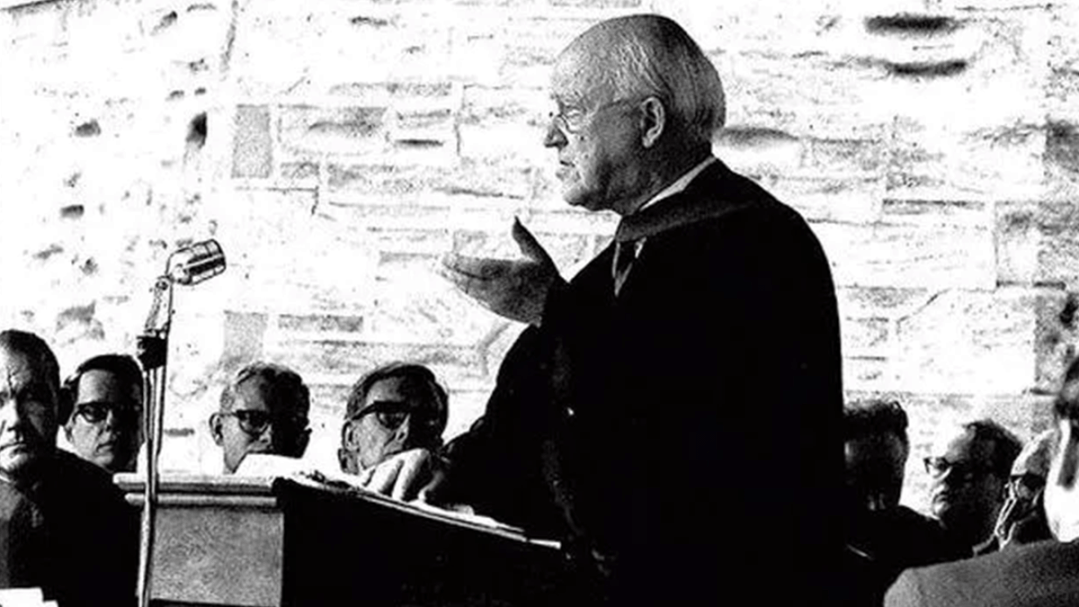
As British evangelicalism approached the precipice of their own crisis in 1966, the famed British preacher and evangelist, D. Martyn Lloyd-Jones passionately encouraged evangelicals to leave their floundering denominations. As he made clear in his Appeal, he was done with paper churches. Speaking of the impulse to define the local church by creeds and statements of faith, the Doctor said,
I am sorry, I cannot accept the view that the church consists of articles or a confession of faith. A church does not consist of the Thirty-Nine Articles. A church does not consist of the Westminster Confession of Faith…A church consists of living people.
At first glance, the Doctor seemed to be affirming the often-heard statement of “No creed, but the Bible” as he headed off into the world of Christian experience. But while the fiery Welsh Preacher of Westminster Chapel certainly affirmed the authority and sufficiency of the Bible and the importance of the universal Christian experience of conversion, he had not given up on creeds in 1966.
Lloyd-Jones & The Importance of Creeds
He taught that the church’s survival depended upon the existence of creeds. Reflecting upon the practice of the early church, Lloyd-Jones said, “They defined heresy, and condemned it, and excommunicated men who taught it…The result was that we have the so-called great creeds of the Church – for instance the Apostle’s Creed.” What proved true of the early church also proved true of the Protestant Reformation and of the Church during other times of revival. Lloyd-Jones continued,
The Church in every period of revival and awakening, when she is really alive…has always done this very thing. The drawing up of a Confession is nothing less than a way of ‘girding up the lions of your mind,’ or ‘putting on the girdle of truth.’
In other words, the historic, evangelical church has always welcomed creeds and statements of faith because they were “drawn up to save the life of the Church and to safeguard the truth concerning our Lord and His salvation.” Lloyd-Jones believed that those who held fast to the Scriptures would hold equally fast to documents such as “the Westminster Confession.”
In critiquing paper churches, Lloyd-Jones was not expressing antagonism towards creeds but rather towards their misuse. In other words, he did not oppose the presence of creeds but rather those disingenuous pastors and denominational workers who signed orthodox creeds so that they could teach heterodoxy if not outright heresy apart from any criticism. In the 1960s, British liberals engaged in the doublespeak that defined the liberals wing of the SBC during the conservative resurgence of the 1980s and 90s. In front of boards and councils, they publicly affirmed orthodoxy. But in their Tuesday morning lectures and their Sunday morning sermons, they openly attacked core biblical doctrines. Reflecting upon this reality in 1969, Lloyd-Jones remarked, “What the Christian church is teaching at any given time is what is being proclaimed from its pulpits and not what is handed down on paper.”
Though the British liberals hoped to revive their struggling churches through the inclusion of more culturally adept theology, their broadening theological horizons did not translate to increased membership. The grand cathedrals of old were transformed into flimsy and empty paper structures. As Lloyd-Jones noted, “If you mix with polluted doctrine, it is not surprising that you become diseased and more or less useless in the kingdom of God.” Those who abandoned or diluted the creeds would ultimately lose the gospel and their churches. He warned, “if you make what appears to be a minor change somewhere on the circumference it will soon have its effect even upon the center.”
Warren & the Baptist Faith and Message
In a few days, the SBC will face its own crisis. The messengers at the 2023 SBC Annual Meeting will have to decide whether they will reinstate Rick Warren’s old church (Saddleback Church) which has ordained and installed women pastors, violating the SBC statement of faith, the Baptist Faith in Message 2000, and its biblical moorings (and for what it’s worth – Lloyd-Jones’s teaching). With that vote, Southern Baptists will determine whether their confessional documents exist to protect the integrity of the gospel or to protect those who teach against the Bible from institutional and biblical accountability. In other words, they will be determining whether the SBC is a living or a paper denomination.
May they choose wisely.
What Did they Decide?
In God’s kindness, the messengers at the 2023 Annual Meeting affirmed that creeds exist to uphold the clear teaching of the Scriptures. They rejected Warren’s appeal to reinstate Saddleback Church by a vote of 88% to 11%. I am thankful to report that the SBC is not a paper denomination. As of 6/14/2023, it is very much alive!
 Witkowski Blog
Praise the Lord,
SBC is not a paper denomination!!
LikeLiked by 1 person