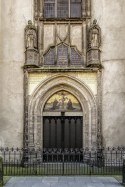
 On October 31, 1517, Martin Luther set off an earth quake that would reorder Christendom with a few taps of a hammer and with a postage stamp. Luther did not believe that his 95 thesis which first appeared on the door of the Wittenberg Chapel and that were mailed to Cardinal Albrecht of Mainz were controversial. Rather he saw his document as reforming abuses of Catholic doctrine. A few months earlier while delivering his Disputation Against Scholastic Theology, Luther had said,
We do not become righteous by doing righteous deeds but, having been made righteous, we do righteous deeds. This in opposition to the philosophers.
Luther had knowingly criticized core church doctrines as evidence by his phrase “in opposition to the philosophers”, but he still believed he was in full “agreement with the Catholic church and the teachers of the church.” He saw himself as recovering the historic Catholic Faith. No one in the Catholic church which held to salvation by grace and works blinked. Quite naturally, Luther believed he had to freedom keep criticizing the abuses within the Catholic Church.
In 1517, Luther indirectly encountered a larger-than-life abuser of Catholic doctrine in the person of Johann Tetzel who was a Dominican Friar entrusted with the sale of indulgences. The indulgence was a little piece of paper that absolved Christians from their venial sins.
The Christian would confess their sins to the priest. While God’s grace covered the sin’s guilt, the sin’s punishment became the domain of the priest upon confession. The priest was then responsible for forgiving the punishment of the Christian’s sin. To show that he or she was worthy of the priest’s forgiveness, the believer would do good works, such as saying prayers, taking pilgrimages, and kissing of artifacts. And if a man or woman could not pay for all their sins in this life, they would be sent to purgatory, an eternal place above hell and below heaven where sinners still stained by sin paid off their remaining sin debt in preparation of heaven. But if the Christian bought the indulgence the penalty of their sin was covered by the Popes excess grace. God had given the Pope more grace than the Pope needed. Thus, the Pope happily shared it with poor, common sinners for a price. As Tetzel said, “When a coin in the coffer rings, a soul from purgatory springs.” Half the proceeds went to Rome to build St. Peter’s Cathedral and half went to the Bishop of Mainz.
Though Luther never directly encountered Tetzel because the indulgences peddler was prohibited from entering Duke Ferdinand’s territory, Luther’s congregants were able to travel to Tetzel’s salvation market. They returned with troubling stories. He reported the following to Cardinal Albrecht,
Evidently the poor souls believe that when they have bought indulgence letters they are then assured of their salvation. They are likewise convinced that souls escape purgatory as soon as they have placed a contribution into the chest.
Luther could not help but respond. And so, he wrote the 95 Theses. The five theses below capture thrust of his concerns and beliefs:
-
Any truly repentant Christian has a right to full remission of penalty and guilt, even without indulgence letters.
-
Christians are to be taught that if the pope knew of the exact actions of the indulgence preachers, he would rather that the basilica of St. Peter were burned to ashes than built up with the skin, flesh, and bones of his sheep.
-
The true treasure of the church is the most holy gospel of the glory and grace of God.
-
Christians should be exhorted to be diligent in following Christ, their head, through penalties, death, and hell.
-
And thus be confident of entering into heaven through many tribulations rather than through the false security of peace [Acts 14:22].
Though Luther began the debate of indulgences within the walls of the university and the church, the subject of salvation was also on Luther’s mind.
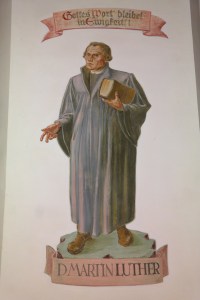 On July 17, 1505, Luther entered the Augustinian Monastery in Erfurt much to his father’s dismay. Luther had been destined for a career in Law. But on July 2, 1505, he had been caught in a severe thunderstorm. As thundered boomed overhead and as lightening flashed about him, Luther promised St. Anne that he would take monastic vows and devote his life to the church if he survived. Luther made it out alive. And so, he began serving the Catholic Church, happily embracing her doctrine of salvation by grace and works. Luther noted in 1545 that
I was once a monk and a most enthusiastic papist when I began that cause.
Luther sought salvation through an excruciation mean such as sleeping on the ground and whipping himself. He did so because the Catholic church taught that God only awarded grace to those who demonstrated a propensity for holy living, in the same way some would demonstrate a propensity for baseball, or metal working, or organization.
Luther sought to earn God’s grace which would then justify him and cover his sin debt. But as Luther become a priest and then a doctor of theology, he found himself constantly failing God. Yes, he worked hard. He would confess sins for hours, study for days, and fast for weeks. Yet, he was never able to be holy enough for God. Luther commented,
Though I lived as a monk without reproach, I felt that I was a sinner before God with an extremely disturbed conscience. I could not believe that he was placated by my satisfaction. I did not love, yes, I hated the righteousness of God who punishes sinners…I was angry with God.
Luther knew he was not holy. He knew God was infinitely holy. And he knew that this holy God called Luther to be Holy. Luther felt like the 4’ kid on the basketball court who is commanded to dunk on the 10’ rim. God was asking him to do the impossible.
Then by God’s grace, Luther read Romans 1:17:
For in it the righteousness of God is revealed from faith for faith, as it is written, “The righteous shall live by faith.
By God’s grace Luther realized salvation was not earned it was given. Luther recounted the moment as a follows:
There I began to understand that the righteousness of God is that by which the righteous lives by a gift of God, namely by faith. And this is the meaning: the righteousness of God is revealed by the gospel, namely, the passive righteousness with which the merciful God justifies us by faith.
As Luther later summarized in his Heidelberg Disputation ,
The Law says, “do this,” and it is never done. Grace says, “believe in this’” and everything is done already.
Thus, Luther wrote the 95 Theses convinced that salvation comes through grace alone by faith alone apart from the works of the Law and the deeds of the church. Luther wrote his Theses thinking his position was the position of the silent majority position over the church. He was about to be rudely awakened.
When Cardinal Albrecht read the 95 Theses and Luther’s Sermon on indulgences, the Cardinal quickly forwarded Luther’s writings onto the Pope Leo X. The upstart monk was criticizing an important source of income, was denying Papal authority, and was challenging the doctrine of salvation. Albrecht believed Luther needed to be stopped before he harmed the church.
Because the Pope wished to have Charles V elected as the next Holy Roman Emperor, he needed Duke Ferdinand’s support. Thus, Luther was examined by the papal legate Catejan at the Diet of Ausburg instead of being called to Rome. Luther was told to recant twice and refused both times, irritating Catejen.
In 1519, Luther ordered to attend the Leipzig Disputation. He entered into two week debate with Johann Eck and others. Towards the end of the debate, Eck labels Luther a Hussite. The Hussites were named for their founder Jon Huss who had been burned at the stake in 1415 for teaching the Popes could err.
Thus the Pope is not the head nor are the cardinals the entire body of the holy, Catholic, and universal Church. For Christ alone is the head of the Church and all predestined together form the body, and each alone is a member of that body, because the bride of Christ is united with him.
Unfamiliar with Huss, Luther asked and received a recess to study the works of Huss. When Luther returned to the debate, Luther boldly declared that he stood with Huss and his teachings! Luther boldly said,
The truth of the Scriptures comes first. After that is accepted one may determine whether the words of men can be accepted.
Eck had forced Luther to admit his disdain for papal authority. With a clear understanding of Luther’s theology, Pope Leo X issued a papal bull officially commanding Luther to recant on June 15, 1520. Luther responded by burning the Pope’s order.
The church was ready to arrest the troublesome monk, but Luther tossed the church a curveball asking for a secular trial. Seeking to promote political unity, the Emperor Charles V created the Diet of Worms in April 1521. When Luther appeared before the council, the council ordered Luther to recant once again. Luther asked for a day to think over his answer. When Luther returned the following day, he delivered his now famously response.
Unless I am convinced by the testimony of the Scriptures or by clear reason (for I do not trust either in the pope or in councils alone, since it is well known that they have often erred and contradicted themselves), I am bound by the Scriptures I have quoted and my conscience is captive to the Word of God. I cannot and will not recant anything, since it is neither safe nor right to go against conscience. May God help me. Amen
All hopes of quieting the disgruntled German pig were dashed. Luther was condemned by the Catholic Church. And Luther condemned the Catholic Church for teaching a false gospel. The earthquake started on October 31, 1517 had now become fisher of continental proportions.
On May 26, 1521 the Charles V issued the Edict of Worms. Both the church and the state had now condemned Luther to be a a heretic . Charles V commanded his subjects to: “seize him and overpower him, you should capture him and send him to us under the tightest security.”
Understanding the gravity of Luther’s situation, the friendly Duke Ferdinand arranged for Luther to be kidnapped and taken safely to Wartburg Castle. While living in the castle, Luther would translated the Bible into German. Once the political climate died down, Luther came out of hiding and began to advocate for reformation theology, writing numerous books and catechism, and addressing societal concerns. In 1527, he married the former nun Katharina Von Bora. Together they had six children. Two of the children died in childhood. Luther spent the reminder of his life, preaching, teaching, and discipling men and women in faith. He died on Feb 18, 1546 at the age of 63. Though Luther has long been removed from the theological scene, his influence lives on today because he recovered the gospel once deliver for all! As Luther said of himself:
“I simply taught, preached, wrote God’s Word; otherwise I did nothing. And then while I slept, or drank Wittenberg beer… the Word so greatly weakened the papacy that never a prince or emperor did so much damage to it. I did nothing. The Word did it all.”
 The church stands as a beacon of hope in this crazy fallen world. Believers are able to survive the trials and storms of life by depending upon the Holy Spirit who nurtures and sustains their souls through the faithful local church which preaches the gospel and administers the sacraments of Baptism and the Lord’s Supper.
 In 1 Peter 5:1, Peter addresses the elders in the church. He does not address the elder but the elders, plural. God designed his church to be ruled by a plurality of men. A quick survey of Acts and the Pauline letters supports Peter’s assumption. Acts 14:23 says, “And when they had appointed elders for them in every church, with prayer and fasting they committed them to the Lord in whom they had believed.” Acts 20:17 states, “Now from Miletus he sent to Ephesus and called the elders of the church to come to him.” In 1,2 Timothy and in Titus, Paul tells his sons in the faith to, “put what remained into order, and appoint elders in every town as I directed you.” And in Philippians 1:1, Paul writes to, “To all the saints in Christ Jesus who are at Philippi, with the overseers and deacons.” The local church should be led by elders and served by deacons (Acts 6).
 Witkowski Blog