Why the Big Fish is Not the Craziest Thing in Jonah

The most shocking element of the Jonah narrative is not the fish that swallows the cantankerous prophet. It is the providential mercy of God who saves both the cantankerous prophet and the people of Assyria.

Why Was Jonah’s Sin?

When Jonah receives word to go to Ninevah, he disobeys God and heads into the dark hull of a ship destined for the other side of the known world. Though some scholars believe Jonah’s revulsion to the Assyrian empire was driven by racism and cultural prejudice, the author of Jonah makes no such claims. Jonah most certainly did not view the culture that made a name for itself by creating towers with its captives’ skulls favorably. But he did not run from them because of unsubstantiated fears about what they might do to him. He ran from his God because he desired to save the wicked.

Though Jonah’s nebulously short sermon might appear to be an early Bible-thumping, fire and brimstone message, it was nothing of the sort. It contained illusions to both God’s wrath and his mercy. The word translated ‘repent’ in Jonah 3:4 could also mean to overturn or change. In other words, Jonah’s message could have had a double meaning: destroy sin or be destroyed by sin. Moreover, Jonah’s mention of 40 days would have also reminded the original Hebrew listeners of both Moses and Noah. After 40 days, Moses came down from the mountain and condemned the nation of Israel for having worshiped a golden calf. Conversely after 40 days, Noah emerged from the Ark having survived the flood. Thus, number 40 contained both the potential for death and salvation. And it was this very possibility of forgiveness that troubled Jonah’s soul.

When the prophet gives us unfiltered insight into his motives, he says, “That is why I made haste to flee to Tarshish; for I knew that you are a gracious God and merciful, slow to anger and abounding in steadfast love, and relenting from disaster (4:2).” Jonah ran not from geopolitical realities but from the idea that God would save the sinners…sinners who cared nothing for the laws and regulations of God’s word
In other words, Jonah took no issue with the salvation of those who offered sacrifices and faithfully read the Torah. When God miraculously sent a great fish to save Jonah from his suicidal embrace of sin, the prophet rejoices in God’s salvation. We too rightfully rejoice in the knowledge that God saves believers who wander into the darkness of sin and unbelief. Many a Christan can say with Jonah: “Out of the belly of Shoel I cried, and you heard my voice (Jonah 2:1b).

Why Did God Save Jonah?

The struggle comes not when God extends the grace to our friends or to those share our political affiliations or to those sit next to us at church. The struggle comes when God saves those that we hate because they have unquestionably sinned against us and those that we love in the cruelest of ways. It’s one thing to see your friend’s marriage restored or to praise God for liberating the hostages taken by Hamas. It’s quite another thing to pray for the salvation of the man or the woman who almost destroyed your marriage or to encourage you child to share the gospel with the leaders of Hamas. It is this tension that drives us into the crux of Jonah’s anger and into the gloriousness of the gospel. God’s mercy is undeserved.

Jonah did not make it to Nineveh on his own merits or efforts. When Jonah threw his second temper tantrum because God had killed the plant that had shaded Jonah from the hot sun the day before, God reminded Jonah of the plant’s origin. Jonah 4:10 records God saying, “You pity the plant for which you did not labor, nor did you make it grow, which came into being in a night and perished in a night.” In other words, the earthly salvation that Jonah so loved came freely from the Lord and not from Jonah. Similarly, the only thing that Jonah brought to the story of the great fish was his suicidal bent towards destruction that made God’s saving grace necessary. Jonah had no more right to lay claim to God’s mercy than any sinner in Nineveh. God’s mercy is always underserved, unmerited, and freely given. Since Jonah deeply longed for even little displays of God’s mercy, he could not begrudge God for extending that same mercy to even worse sinners. In short, the message of Jonah is that we should praise God for saving us and our enemies. Same mercy that saves the kid in Sunday school saves the terrorist abusing his neighbor.

How Do We Apply Jonah to Our Lives?

At this moment, the realities of God’s love shatter the imperfections of our love. When God calls us to love our enemies, he calls us to do more than avoid overtly sinning against them (which for many of us is the summation of our love for our enemies). We cannot slander or rage against those who have campaigned against our political party, disrupted our family get-togethers, or destroyed our marriages. But love demands that we must do more than refrain from doing them evil. We must work for their salvation. Those whom we can’t stand are the very men, women, and people groups that we should be praying for and evangelizing. Augustine compared the Christian’s love for his enemies to the physician’s love for the sick, writing, “He loves the sick, not that they remain sick men but so that they may become healthy instead of sick.” To love as God loves, we must long to see our enemies saved from the wrath to come. This is the most radical aspect of the book of Jonah…the sovereign mercy of God. May God give us the grace to love the Ninevites in our life as God loved us.
3 Truths From Bunyan That Will Help Our Kids Survive Today’s Intolerant Culture:

religious-intoleration-blogGod never intended for our religion to be a personal, private thing. Yet, we are increasingly told by our society to make it so. Our kids are told to avoid prayer and religious conversation. What is good in the home is now deemed evil when it becomes public discourse. Talking of Christ is deemed to be divisive and hurtful by our culture.

How do we respond? Do we encourage our kids to obey their authorities? Or do we encourage them to rebel and protest?

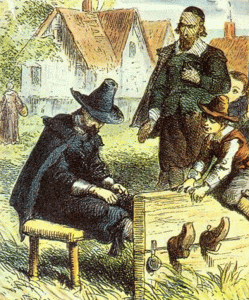
The pastor and theologian, John Bunyan, faced a similar complaint several hundred years before us. He was encouraged by the legal system of his day to keep his religious beliefs within the confines of his “family.” When he refused to keep his religion to himself, Bunyan was thrown into jail. From his life and testimony, we can learn three things about how to respond to lack of religious toleration in the 21st Century.

1. What is good for the home is good for all:

The soul that clings to Christ will increasingly become more loving, kind, patient, and caring. And since talking about God and the Bible helps knit our souls and character ever closer to God’s Word, we must make it a point to talk of Jesus in our home. And since it is good for us to talk of Jesus in our home, we must be willing to talk about him in our school. Does this mean that everyone will like us? No. Does this mean some will be offended at our words? Yes. But if we truly believe God’s Word has life within it and that it possesses the power to change people for their and our society’s good, then we must share it with others even when teachers and lawmakers tell us not to speak. As Bunyan said,

If it was lawful to do good to some, it was lawful to do good to more. If it was good duty to exhort families, it was a good to exhort others.

2. Don’t hold anyone captive:

Bunyan spoke boldly for Christ. Some estimate that thousands of people would come to hear the tinker’s sermons, which were often delivered in a barn or field. But Bunyan was very clear. He did not force anyone to listen to him. He was gracious to all. As he told his judges,

I shall not force or compel any man to hear me; but yet if I come into any place where there is a people met together, I should according to the best of my skill and wisdom, exhort and counsel them to seek of the Lord Jesus Christ, for the salvation of their souls.

In short, Bunyan did not attack anyone with the Bible. If they would not hear him, he left them alone. But if they would hear him, he would boldly proclaim Christ. We too must respect the wishes of others. If they ask us to let them be, if they ask us to stop sharing Christ, and if they tell us no thank you, we must respect their wishes. But if they will hear us, we must preach Christ. We should always be ready to preach and counsel like Bunyan was. But we must never force anyone to hear us against their will.

3. We must remember our allegiance is to Christ:

If we stand on the gospel, we will not be popular with all people. They will ask us to stop even our respectful communication of truth. Our kids very well may be threatened with bad grades, expulsion from school, or banishment from the starting roster. But when the time comes, we must stand with Christ. This world and all its honors are passing away. If we conform our faith to the will of those around us, we will deny Christ and find only despair. But if we cling to Christ as Bunyan did and experience our own prison sentence, we can trust that God will take care of us. As Bunyan wrote,

Let the rage and malice of men be never so great, they can do no more, nor go any further, than God permits them; but when they have done their worst, We know all things shall work together for good to them that love God.

Our allegiance first and foremost must be to Christ. Are you and your kids ready to follow Him?

What Our VBS Says About Homosexual Marriage

gay marriage blogFriday (June 26) was a huge day for us! The Supreme Court made self-actualization the highest law of the land, and FBCE wrapped up Vacation Bible School. I know, typically those two things would be non-sequiturs. But this week our VBS curriculum had a lot to say about homosexual marriage. (No, our theme was not sexual ethics. We used Lifeway’s Journey off the Map) All week, students at FBCE studied the Life of Daniel and his friends. And we saw how Daniel lived faithfully for God in a pagan, unbiblical society. Instead of being crushed by the Persian and Babylonian cultures, Daniel exceled in godliness and became a political guru.

And while I am not excited about the Supreme Court’s decision to legalize homosexual marriage, I am also not afraid of the court’s actions. Christians can live for God in a hostile world. We can thrive in the midst of pagan humanism and persecution. God is faithful and cares for his people all over the world. He supported and sustained Daniel. He supported Paul and Peter in Rome. He has and will always care for his people! We don’t need to panic. We need to trust God today.

Day3And there is a good chance things will get worse. We may soon face laws restricting our faith just like Daniel did. It’s quite possible WordPress, Twitter, and others will begin banning anti-gay speech. Here’s why:

The recent ruling has given the homosexual community most everything they want.  And they truly think that the ability to freely marry will make them happy. But lighting up the White House with rainbow colors won’t fulfill them. No amount of sexual expression can bring us lasting joy. Only Christ satisfies our souls. As the days plod along, society will once again feel angst. And I fear homosexuals will blame “bigoted” Christians for their troubled consciences.  If everyone accepted homosexuals, they wouldn’t feel bad. Or so they think. Thus, homosexuals will begin looking for ways to eliminate all negative comments about their sexuality. Even today, newspapers have begun banning anti-gay letters from the editorial pages. Soon they will want to monitor our homes and churches.

Again, we don’t need to panic. But we need to understand where America stands. And then, we should strive to be like modern day Daniel’s by doing the following.  First, we help our kids understand the Biblical view of marriage, by modeling it and talking about it. Second, we can remember that being a Christian equals enmity with the world. We fight against the sins of pornography, greed and selfishness that infect our hearts. And lastly, we demonstrate the love of Christ by caring for all our neighbors (regardless of their sexual expression). Are you ready to live in a post-Christian world?

Do not be conformed to this world, but be transformed by the renewal of your mind, that by testing you may discern what is the will of God, what is good and acceptable and perfect. – Romans 12:2

Here are some other great resources discussing homosexual marriage:

Everything Has Changed and Nothing Has Changed – The Supreme Court Legalizes Same-Sex Marriage

Here We Stand: An Evangelical Declaration on Marriage

The Only Decision That Matters

Parenting in A Gay Marriage World. What Should Christians Do?

Is God Anti Gay?