From Sochi to Salvation: A Brief Theology For The Parents of Sport’s Nation

Slide_From Sochi to SalvationThe screaming, jumping, whooshing, waving, and excitement of the Olympics is here. And as we click on T.V. screens to see which flips, spins and twists were medal worthy, we also are treated  to fascinating personal interest stories. Whether they are covering a petite figure skater or a rough snowboarder, all of the interviews reveal that a spot on the medal podium requires a lifetime of personal and familial sacrifice. As Christians, we are often awed by these athletes’ devotion and wowed by their success. Naturally wanting our children to succeed, we start to wonder if we should send our five-year-old girl off to Michigan to practice figure skating or sign up our ten-year-old son for college football camps in Alabama. What should Christian parents do?

Go Sports Go

Before we zing off to the slopes, the beach, or the practice field, we first need to ask, “Do Christians belong in sports?” I believe the answer is a resounding yes! God has made us physical creatures. He has given us the ability to run, jump, and create fun competitions.  As Exodus 28:3, Exodus 35:35, and I Kings 7:14 make clear, all human skills are gifts from God. Even the ability to ski down a mountain or to dribble a soccer ball is a present from our creator. Moreover, sports provide us with the opportunity to relax, fellowship, and responsibly care for our bodies. Employing several sporting analogies, the apostle Paul confirmed that “bodily training is of some value (I Timothy 4:8).”  We can and should encourage our children to participate in sports. We and our children belong in sports’ nation.

The True Value of Sports

Yet as C.J. Mahaneny noted, “as soon as you introduce the human heart, things get complicated” (Mahaney 2010, 9). We can’t blindly encourage our kids to just “do it” every time the practice field opens.  We need to realize that sports are only valuable when done to the glory of God. When we and our children use sports as an opportunity to encourage others, to accept correction, to serve our friends, to praise God, and to share the story of salvation, sports’ nation is a good thing  (I Cor. 10:13).

But, we cannot value sports’ nation simply for the sake of sports. If we do, sports’ nation become more dangerous than facing Barry Bonds in the bottom of the ninth inning with the base loaded and no outs. Nothing created, not even the cute, little guy wearing a T-ball jersey two sizes too big, should take the place of Christ.  If we covet success and fame for our children, we transform sports into an Idol. And, covetousness is idolatry (Col. 3:5). If we inflate the value of sports, “Worship is happening – on ESPN and in our hearts” (Mahaney 2010, 40).

Admittedly, we cannot keep little, prideful hearts from boasting in thirty mile-per hour fastballs and three inch verticals. We cannot redeem our miniature superstars (Ez. 18:20). But we can point our children to Christ through our actions! Sports played for the glory of god are immensely valuable.

Breaking God’s Rules

Now, it’s time for the practical side of things. If we fail to follow God’s rules and place our children’s sports’ career above the things of God, our lives will show it. As Paul David Tripp notes, “You are always attaching your inner hope and contentment to something, and when you do, those things take on life-shaping value” (Tripp 2012, 103). Family devotions will be replaced with never ending practices. Church attendance will be regularly bumped off the calendar by weekend tournaments. And, our bank accounts will see giving withdraws redirected to season tickets, uniforms, and that all important swag. Words of gracious love spoken to our children will be replaced with criticism, rants against officials, and complaints about coaches. By virtue of our actions, we will teach our children that the gods of sports’ nation will give them, “what the God the Bible cannot give – success by worldly standards” (Baucham 2007, 38). We will prepare our children to gain their lives only to lose them. And at the end of the day, we cannot be surprised to see our children mature into adults who place the world before Christ. As Voddie Baucham warns, “We cannot expect our children to rise above our example” (Baucham 2007, 40).

Playing God’s Way

For our children’s sports’ activities to glorify God, we must place them comfortably behind Christ, our marriage, and our family. We are children of the king, designed to worship Christ. The prize we should most value and most want for our children is the one consisting of eternal glory (I Tim. 4:8). It is the prize that requires one to lose his life to gain it (John 12:25). It’s the prize that our children can get only through hearing the word of God preached and the seeing the word of God lived out faithfully by their parents and other believers (Deut. 6). Such instruction is far better than any scholarship, trophy, or medal.

Below, I’ve list a few practically ways we can use sports to point are children to Christ. The following is taken mostly from C.J. Mahaney’s book Don’t Waste Your Sports:

  1.  Celebrate godliness. We should praise our children for making it to the podium and for hitting a homerun, but we should praise their humility, diligence, and self-control even more.
  2. Prize your family. If your children’s gymnastics event or if watching the Olympic snowboard competitions dominate your family life, cut back on your sports. Skip a practice, turn off the T.V. and spend time studying the word and/or praying together as a family or take your wife on a date.
  3. Guide Your Speech. Speak truth in love. Strive to only say things that support, encourage, and build up your children, the coaches, and the officials. God is sovereign even over peewee football. Are words should reflect our faith in his control.
  4. Love your local church. Missing a Sunday morning or two “doesn’t make you guilty of idolatry” as C.J. points out (Mahaney 2010, 41). But, we can still help our children understand that God comes first. When events fall on Sunday, we can miss practice, arrive late, or visit other Bible believing churches.
  5. Train for life. Use your children’s sporting failures and successes as opportunities to teach them about their hearts and about the character of the one true God.

Game On

Sports are a blessing. For the sake of for disclosure, I must confess that I am sports’ enthusiast.  I played baseball until my sophomore year of college. My office is decorated with mini football helmets. I celebrated the coming of my first son by purchasing Chicago Cubs onesie. I even find aspects of Olympic curling to be interesting. As my wife can attest, I am a sports’ junky.

But for all of its benefits and life lessons, sports’ nation will never save. Red Sox Nation, Wrigley Field, and Sochi will all burn. If you start place sports’ nation behind your marriage, family, and church, your child may slide from starter to sub. But isn’t eternal life worth the earthly cost? Is there anything that we or our children sacrifice on earth that will not be returned a thousand times over in heaven? Let’s encourage our children to use their athletic ability to glorify their creator. Let’s point them to salvation!

Recommended Resources

Baucham, Voodie Jr. Family Driven Faith: Doing What it Takes to Raise Sons and Daughters Who Walk With God . Wheaton: Crossway , 2007.

Mahaney, C.J. Don’t Waste Your Sports. Wheaton: Crossway, 2010.

Tripp, Paul David. Dangerous Calling . Wheaton : Crossway , 2012.

From YMCA to Veggie Tales: Children’s Ministries That Last

Blog_YMCA to Veggie TalesJust like its namesake song, the YMCA is quickly becoming classic of a bye gone era. The Christian gyms famously devoted to reaching young men are being replaced with Veggie Tale concerts, Winshape Camps, and a wild assortment of other pubescent activities. Every day churches are updating nursery facilities, hiring children’s pastors, and launching new kids’ programs. Children’s ministry is the new youth ministry. And in many ways the focus upon children’s ministry is a good thing. According to Ken Ham, some forty percent of those who leave the church decide to check-out during their elementary or middle school years.[i] We need to do a better job of reaching our children for Christ. But before we hire a themer or create the hottest new curriculum, we need to ask ourselves what is the goal of children’s ministry?

According to scripture, the twelve and under program should consist of the following three headliners: the gospel, parents, and discipleship.  Before we can look at putting together an A-list children’s ministry, we first need to understand our audience.

In the Psalms, we discover that all babies enter the world infected with sin.  According to the Psalmist, “The wicked are estranged from the womb; they go astray from birth, speaking lies” (Ps 58:3). The teaching that all children are born with “iniquity” is reinforced in Psalm 51:5 and in Romans 3:23. Reflecting upon these and other passages, the famed theologian J.C. Ryle commented, “one thing a mother can say with certainty: [her infant] will have a corrupt heart.”[ii] Similarly, Elyse Fitzpatrick and Jim Newheiser wrote,

“Children are not good by nature; they are not a “blank slate” upon which we can write our values; they are not inherently innocent, nor are they genetically predisposed to be good. In fact, the Bible teaches that they are genetically predisposed to be bad because every child is born with original sin and a rebellious nature.”[iii]

All babies and infants (and I would argue a majority of preschoolers, elementary students, and middle schoolers, “the intention of man’s heart is evil from his youth.” Gen. 8:21) first encounter children’s ministry as an unbeliever with little to no knowledge of the gospel. What do we do with these precious little ones?

First, we introduce them to the gospel! According to Deuteronomy 6:1-25, we are to teach our uniformed, little sinners the word of God through Sunday school lessons and through our actions. We do so hoping that the Holy Spirit will spark questions in the hearts of our children that will burst into the glorious flame of salvation. As Paul says, the law is the tutor, the teacher, by which we come to Christ (Gal. 3:24). Before we bring out Lottie Moon or anything else, let’s expose our children to this firm yet wonderful teacher.

Secondly, we need to welcome parents onto the children’s ministry stage. In Deuteronomy, Moses charges parents with the primary responsibility of reaching their children for Christ.  We are told that children will ask parents (not pastors or Sunday school teachers) about spiritual matters. Consequently, I believe equipping parents to disciple their own children is one of a children’s ministry leader’s most important tasks. As I look back over my time in children’s ministry, I have seen ample evidence of this truth. The number of children who came to Christ while interacting with their parents far out paces the number of professions made at camps or vacation bible schools.  Not surprisingly, every child that I have counseled has come to my office accompanied by a loving parent who has been fielding their child’s spiritual questions.  Let’s strive to equip our parents to bring up their children “in the discipline and instruction of the Lord” (Eph 6:4b). During the next few weeks, I look forward to tackling the subject of “leading your child to Christ” in more detail.

Although parents our charged with caring for their children’s spiritual formation, their calling does not negate the importance of the church. Psalm 78 reveals that teaching the next generation also contains a corporate element that extends beyond the immediate family dynamic. As J.C. Ryle notes, “Few can be found, I think, who might not influence some parent in the management of his family, or affect the training of some child by suggestion or advice.”[iv] When we have children in our homes, or in Sunday school rooms, or in Wacky Wednesday gyms, we should remember Deuteronomy 6, Psalm 78, and Ephesians 6. We are to partner with parents by diligently teaching all children the gospel story in a loving, engaging manner. “Both [the family and the church] have been given the task to disciple young people.”[v]

Thirdly, we introduce these warmed up crowds of little people to discipleship. Regardless of our audience’s age, we are called to make disciples not converts (Mathew 28). Consequently, we should make truth for growth a valued member of our gospel focused, children’s ministries. We should teach on Ephesians 6, encouraging our children to obey their parents. We should teach young Christians to put on the “tender mercies, kindness, long suffering” of Colossians 3. But, we must do so in a manner that also recognizes many of our listeners lack regenerated hearts and gospel knowledge. As children’s pastors, teachers and workers, we must remind all the souls under our influence that the Christian life is impossible without Christ. We must constantly show our children their sin and then introduce them to the Jesus who saves and transforms all who call upon his name.

Who knows if Veggies Tales will become a heralded classic or if the cute vegetables will return to forgotten produce isle? But this we do know. The word of God will never pass away (Mat 5:18). If we faithfully build our children’s ministries on the Bible by proclaiming the gospel, equipping parents, and on discipling children, we will escape the bounds of irrelevance.


[i] (Ham, Beemer and Hillard 2012,) Ken Ham also points out that another 50% of those who leave church decide to do so during high school. I wish in no way question the validity of youth ministry as it has a special place in my heart. I came to Christ under the preaching of a faithful youth pastor. I only wish to point out that the enthusiasm of yester year that went into youth ministry has now been redirected towards children.

What To Expect When No One’s Expecting

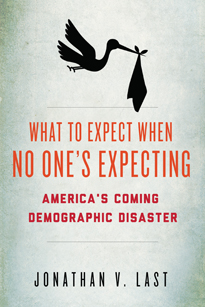
what to expect when no one is expectingJonathan V. Last. What to Expect When No One’s Expecting: America’s Coming Demographic Disaster. New York. Encounter Books, 2013. 230 pp. $18.01

According to our God, both the little screaming child who just slapped its mother across the face and the infant peacefully cooing itself to sleep are blessings from above. But the divine perspective of Psalm 127 is quickly losing traction in the world as record number of couples doubt the wisdom of having a house full of children. Seeking to understand why, “only 3 percent of the world’s population lives in a country whose fertility rate is not declining,” what affects childless societies will have upon the world, and how to combat the effects of this childless trend, Jonathan V. Last published What to Expect When No One’s Expecting: America’s Coming Demographic Disaster.

Though not written from an openly evangelical perspective or from a desire to “convince you to have babies” the book’s statistical revelations affirm a gospel centered world view (p. 10). As the reporter turned author found, children are an empirical blessing. When populations begin buying more adult diapers than baby diapers, the world becomes increasingly unstable. In the German state of North Rhine-Westphalia, the government launched a program that converts prostitutes into elderly care nurses (p. 99). In Japan, a nation that is projected to have one baby for every citizen over the age of 100 in 2040, the minister of finance encouraged the elderly to simply, “hurry up and die”[i] to save the country from financial ruin (p. 142). And by 2040, the United States will face its own financial crisis as there will be only be two workers to care for each retired baby boomer, costing each worker $8,578.00 just in Medicare expenses (p. 109). Although Last is aware that a childless world is an unprecedented event, his extrapolation of current research darkens our expectations.

Thankfully, Last does not leave us excepting only gloom. He offers several helpful suggestions that could encourage couples to have babies. He also gives his readers some good news discussing France, Georgia, and societal groups that have seen their fertility rates stay consistent or even rise above the fertility replacement rate of 2.1 children.

Not surprisingly one of these groups with higher than average birth rates is the church. According to Last, 41% of Protestants who attend church at least once a week “say that three or more children is ideal” (p. 86). He goes on to write:

Religion helps marriage and marriage helps fertility – the end result being that religiosity winds up being an even better predictor of fertility than either education or income (p. 87).

In short, Christians who value the gospel are having more children.

The challenge for Christians going forward will be to maintain their fidelity to the gospel. The world has increasingly less tolerance for religious ideals.  As Last notes, one’s-self is now the highest priority. Instead of godliness, humanity wants happiness. “Best Life Now,” anyone? And as a result of the world’s narcissism, procreation has become, “an act of self-actualization” (p. 93).

Self-lovers consistently advocate for less and less children. In Japan, a nation formerly known for being pet-crazed, self-love has spawned a new social class, the “parasite single.” These working, college educated women have become Japan’s biggest consumer class by choosing to avoid marriage and to live with mom and dad well into their thirties (p. 145). These women devote almost of their incomes to the pursuit of pleasure. Consequently, Japan’s birth rate hovers around 1.4.

The United States is following suit. The love of self is driving Americans to view pets as “low-maintenance replacements for children.” As late as 1985, fewer than fifty percent of Americans had a pet. Today American pets, “outnumber children by more than four to one” (p. 2). And over the past 16 years, the pet business has grown from a $17 billion to a $43 billion industry. America’s birth rate now sits at 1.9.

So when we hear people wax kindly about how their dogs are their children or when we hear people encouraging a couple to delay having a child until they can get that car, house, raise, etc. we must remember the source.[ii] And then, we must remain faithful to scripture. We must affirm that children (not pets) are a blessing. We must remember that, “the worries of the world, and the deceitfulness of riches,” place our souls in eternal danger (Mark 4:1-13). We need to abandon troubling earthly treasures and embrace the blessing of God (Mark 9:36-37).

Do not be conformed to this world, but be transformed by the renewal of your mind, that by testing you may discern what is the will of God, what is good and acceptable and perfect (Rom. 12:2).

When people or our own hearts doubt the wisdom of God’s plan, we should direct them to scripture first and foremost. But if you are in need of real world evidence that children are a blessing or if you want to know the real world cost of abandoning this divine directive, I would encourage you read What to Expect When no One’s Expecting: America’s Coming Demographic Disaster.


[ii] One word of caution: Speak kindly with those who advocate the above positions. Speak truth in love (Eph. 4:15). It’s possible that the “money lover” truly wishes to spare others the suffering of poverty or that the “ridiculous pet owner” might be barren mother. We need to address the concerns of their hearts with scripture and encouragement.