What To Expect When No One’s Expecting

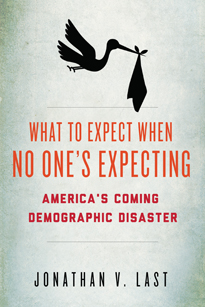
what to expect when no one is expectingJonathan V. Last. What to Expect When No One’s Expecting: America’s Coming Demographic Disaster. New York. Encounter Books, 2013. 230 pp. $18.01

According to our God, both the little screaming child who just slapped its mother across the face and the infant peacefully cooing itself to sleep are blessings from above. But the divine perspective of Psalm 127 is quickly losing traction in the world as record number of couples doubt the wisdom of having a house full of children. Seeking to understand why, “only 3 percent of the world’s population lives in a country whose fertility rate is not declining,” what affects childless societies will have upon the world, and how to combat the effects of this childless trend, Jonathan V. Last published What to Expect When No One’s Expecting: America’s Coming Demographic Disaster.

Though not written from an openly evangelical perspective or from a desire to “convince you to have babies” the book’s statistical revelations affirm a gospel centered world view (p. 10). As the reporter turned author found, children are an empirical blessing. When populations begin buying more adult diapers than baby diapers, the world becomes increasingly unstable. In the German state of North Rhine-Westphalia, the government launched a program that converts prostitutes into elderly care nurses (p. 99). In Japan, a nation that is projected to have one baby for every citizen over the age of 100 in 2040, the minister of finance encouraged the elderly to simply, “hurry up and die”[i] to save the country from financial ruin (p. 142). And by 2040, the United States will face its own financial crisis as there will be only be two workers to care for each retired baby boomer, costing each worker $8,578.00 just in Medicare expenses (p. 109). Although Last is aware that a childless world is an unprecedented event, his extrapolation of current research darkens our expectations.

Thankfully, Last does not leave us excepting only gloom. He offers several helpful suggestions that could encourage couples to have babies. He also gives his readers some good news discussing France, Georgia, and societal groups that have seen their fertility rates stay consistent or even rise above the fertility replacement rate of 2.1 children.

Not surprisingly one of these groups with higher than average birth rates is the church. According to Last, 41% of Protestants who attend church at least once a week “say that three or more children is ideal” (p. 86). He goes on to write:

Religion helps marriage and marriage helps fertility – the end result being that religiosity winds up being an even better predictor of fertility than either education or income (p. 87).

In short, Christians who value the gospel are having more children.

The challenge for Christians going forward will be to maintain their fidelity to the gospel. The world has increasingly less tolerance for religious ideals.  As Last notes, one’s-self is now the highest priority. Instead of godliness, humanity wants happiness. “Best Life Now,” anyone? And as a result of the world’s narcissism, procreation has become, “an act of self-actualization” (p. 93).

Self-lovers consistently advocate for less and less children. In Japan, a nation formerly known for being pet-crazed, self-love has spawned a new social class, the “parasite single.” These working, college educated women have become Japan’s biggest consumer class by choosing to avoid marriage and to live with mom and dad well into their thirties (p. 145). These women devote almost of their incomes to the pursuit of pleasure. Consequently, Japan’s birth rate hovers around 1.4.

The United States is following suit. The love of self is driving Americans to view pets as “low-maintenance replacements for children.” As late as 1985, fewer than fifty percent of Americans had a pet. Today American pets, “outnumber children by more than four to one” (p. 2). And over the past 16 years, the pet business has grown from a $17 billion to a $43 billion industry. America’s birth rate now sits at 1.9.

So when we hear people wax kindly about how their dogs are their children or when we hear people encouraging a couple to delay having a child until they can get that car, house, raise, etc. we must remember the source.[ii] And then, we must remain faithful to scripture. We must affirm that children (not pets) are a blessing. We must remember that, “the worries of the world, and the deceitfulness of riches,” place our souls in eternal danger (Mark 4:1-13). We need to abandon troubling earthly treasures and embrace the blessing of God (Mark 9:36-37).

Do not be conformed to this world, but be transformed by the renewal of your mind, that by testing you may discern what is the will of God, what is good and acceptable and perfect (Rom. 12:2).

When people or our own hearts doubt the wisdom of God’s plan, we should direct them to scripture first and foremost. But if you are in need of real world evidence that children are a blessing or if you want to know the real world cost of abandoning this divine directive, I would encourage you read What to Expect When no One’s Expecting: America’s Coming Demographic Disaster.


[ii] One word of caution: Speak kindly with those who advocate the above positions. Speak truth in love (Eph. 4:15). It’s possible that the “money lover” truly wishes to spare others the suffering of poverty or that the “ridiculous pet owner” might be barren mother. We need to address the concerns of their hearts with scripture and encouragement.

More Than A Name: Three Simple Steps To Parenting

Image

Shortly before the birth of my first child, I happened upon something unexpectedly wonderful, Baby Names Books! These plotless stories are fantastic reads, presenting every possible name from Abrafo to Xipil.  Unfortunately, I found these books to actually make the selection of our baby name trifecta to be all the more confusing. Should we name our baby after grandpa or after the noble of fire?

Similarly, determining how to responsibly parent our newly named person can be equally confusing. Do we go with the “Attachment Method” and breastfeed the little person until it’s a very noticeable three years old; or do we adopt the “Authoritative Parent” model and start telling our three month old, “Our house…our rules kid;” or do we do something different altogether? Thankfully to be godly parents we do not have to shift through thousands of cases studies which detail all of the varying parenting models. To understand how to parent well, we only have to know one book, the Bible!

According to Ephesians 6:4, biblical parenting consists of three simple things: “Do not provoke your children to anger but bring them up in the discipline and instruction of the Lord.” To be a godly parents, we humbly, sacrificially, and selflessly train our children by giving them “practical guidance for living, encouragement, reproof, or chastisement” and instruct our children by teaching them to think biblically, “about God, man, Satan, the world, and life.”[1] Admittedly, these three principles are huge. But through the power of Christ we can attain them. The world may come up with every changing parental guidelines, but we only have to master these three stable principles to be successful parents!arly, determining how to responsibly parent our newly named person can be equally confusing. Do we go with the “Attachment Method” and breastfeed the little person until it’s a very noticeable three years old; or do we adopt the “Authoritative Parent” model and start telling our three month old, “Our house…our rules kid;” or do we do something different altogether? Thankfully to be godly parents we do not have to shift through thousands of cases studies which detail all of the varying parenting models. To understand how to parent well, we only have to know one book, the Bible!

Now, this passage does not directly address many of the issues that span a child’s life such as determining what diapers to buy and when your child gets the keys to the car.  But the Bible can be used to guide us through these and many other decisions. For example, my wife and I could choose to go with disposable diapers because we discovered that our child was allergic to cotton. To place the little person into cotton would “provoke” him/her by making him/her uncomfortable and more likely to be unpleasant to others. Or we could decide not to give our sixteen-year-old the car keys because he/she had been caught cheating on a test. Grounding and restricting privileges helps him/her to understand that liars do not excel at life and that God hates sin. Whether we are deciding on a bedtime or determining the punishment for not doing chores, we are to do so in humble manner, seeking to help our children to be moral citizens and confessors of Christ. (If you are looking for a more in depth look at how to apply scripture to you and your family, I highly recommend the following books: Shepherding a Child’s Heart by Tedd Tripp and The Faithful Parent by Martha Peace & Stewart Scott.)

Before we leave and chance another look at a baby book, we need to consider a word of caution. Namely, we must remember that being a godly parent does not ensure our children’s salvation. Our little ones are much more than their family name. They are souls that “bear the stain of original sin” and experience separation from Christ (Ps 51:5).[2] And just as a name does not determine a person’s future, no amount of humility, instruction, or training on our part will guarantee a child’s salvation. As parents, we can do no work to save ourselves or our children (Eph. 2:8-9). And the great news is that we are not called to save any child and nor are we held responsible for their sins (Ezek. 18:20). We are called to point them to Christ by modeling obedience and by declaring the truth of scripture (Deut. 6:4-9). God saves (Eph. 1:3-5)! If we strive to live out Ephesians 6 and confess our sin when we fail to meet God’s perfect standard, we will have done all that the name above every name has asked of us. We will have been faithful parents!

Gloomy Churches & The Importance of Being Profamily

Rain CloudsUnlike most 78 year olds caught up in worship wars, Lord Carey believes that churches struggle because they are too old fashion. The former Archbishop of Canterbury understands that young people no longer view church attendance to be a societal norm. Wanting millennials to know and embrace the creator of the universe, Lord Carey is calling for Christians to reach out to the next generation. If they do not reach for the hand the next generation, he warns of disastrous consequences. Lord Carey notes:  “

“We are one generation away from extinction – if we do not invest in young people there is going to be no-one in the future.”

Sadly, this phenomenon has left the shores of England and has swept into American churches with supersonic speed. Answers in Genesis, Lifeway, and the Barna Group have all done studies documenting the growing exodus of young people from evangelical churches. These groups also stumbled across the troubling statistic that most young people decided to leave the church by the time they turn fourteen, believing the Bible to have the relevance of a Greek myth (Ham , Beemer, & Hillard, 2012).

Thankfully, everyone from Tom Rainer, the President of Lifeway, to Phil Vischer, the creator of Veggies Tales, is grabbling with the reality that evangelicals are failing to reach the next generation with the gospel. They and the creative teams at Answers in Genesis and Nav. Press have begun providing parents and Sunday school teachers with wonderful materials such as the “Gospel Project”, “Buck Denver’s What’s In the Bible”, and the “Treasuring Christ Curriculum” –  to name a few. Understanding America’s shift to a secular worldview, evangelical leaders are sensing the need to exchange Christian moralism for biblical evangelism.

Yet, resources can only take the church so far. Churches need teachers. They need adults who are willing to love, reach, and engage the next generation. Sadly, most churches struggle to find to men and women to teach their children.  (Barna, 2003).

Many causes contribute to this dark reality, including a lack of pastoral vision, poor training for volunteers, and poor facilities. I believe that all of these causes stem from one source, the devaluation of children. To avert the coming doom, we must first embrace children in our homes.

When the baby boomers slowly welcomed the ideas of Margret Sanger into the church, they transformed the blessed image children into a burdensome statue. Instead of welcoming children as Christ, many baby boomers followed the example of Jesus’ disciples. They elevated their financial stability and their desire to reinvent motherhood above the value of children. Consequently, Christian boomers used birth control to ensuing that children arrived at a convenient time. (Spontaneous pregnancies became an evil)And then, they employed it again to limit their families to the perfect size of one boy and one girl. They desired a life of easy, wealth, and security. They left behind a legacy of Christian books with dedications to two children and family pet.

Consequently, many millennials, like me, grew up hearing that we should delay having children until our lives pictured the American dream. Most of us were told that college degree, a great job, a house with a white picket fence, and two cars should always proceed the arrival of children. We can remember our parents or their friends saying, “I can’t believe how many kids the Jones have; don’t they know how kids are made; I could never love more than two kids, I was glad that the kids left so I could get back to life; why do you want so many children; you are not getting in younger; oh, my children are so much work; Keeping the nursery is the best type of birth control.” We were taught to view worldly possessions and the acquirement of knowledge as the definition of spiritual blessing. Not surprisingly, we now blog about how our favorite family member, the dog, celebrated its second birthday.

Because the church now consists primarily of two generations shaped by the sexual revolution, church members and their pastors often spend little money, time, or effort on ministering to children. Viewed as a holding area for misfit toys, many baby boomers begrudgingly embraced children’s ministry for brief time. But once their children graduated to the treasured island of youth ministry, many boomers returned to land of grownup ministries, consisting of fellowship and travel.

Like our many of our parents, we millennials see Sunday morning as a time of escape from bothersome little creatures. We never enter the country of children’s ministry because it is just another reminder of all that our children have taken or all that potential children could take from us. We want to corporate worship experience to mimic our family values of ease and education.

Friends if we want to revitalize our churches, we need to start embracing children. We must realize that he who labors for wealth and ease apart from Christ labors in vain. We must apply Psalm 127 to our lives, seeing Children as one of the main definitions of spiritual blessing. We should encourage engaged couples to be open to having a baby before they celebrate their first anniversary. We should celebrate the joys of parenthood (especially motherhood as God uses motherhood as a portal for his redemptive purpose- I Timothy 2:15). Rather than promoting the accumulation of earthly treasures, we should advise couples to prepare budget for birth and/or adoption costs. We should structure our churches to equip couples to be parents. And then we must support couples with children through prayers, hugs, gifts, and the occasional warm meal. We must leave the attitude of the disciples behind and embrace the heart of Christ.

If we and our parents create homes that welcome children, I am confident churches will follow. If we are excited to welcome new babies and grandbabies into our lives, we will be excited to invest in the lives of the babies who attend our churches. Encouraged by a right view of family, we will have a heart for reaching children. And equipped with the relevant and gospel centered resources, we will be able reach this and future generations for Christ.

Let’s not embrace the doom of which Lord Carey warns. Let’s embrace children!

SOURCES:

Barna, G. (2003). Transforming Children Into   Spiritual Champions: Why Children Should be Your Church’s #1 Priority .   Ventura : Regal .

Ham , K., Beemer, B., & Hillard, T. (2012). Already   Gone: Why Your Kids Will Quit Church And What you Can do to Stop it. Green   Forest : Master Books.