3 Devotionals For Your 2022 Advent Season

Set against the backdrop of all the Christmas business that threatens to overwhelm us, the season of advent proves to be a blessing. It calls us to pause and to find hope afresh in the Christ child. Here are three fantastic devotionals that will help you and your family care for your soul this Christmas season.

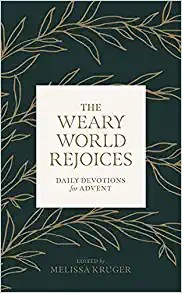
The Weary World Rejoices

Put together by the editors and writers of the Gospel Coalition, this five-week devotional contains focused meditations centered upon the traditional themes of the advent wreath that can be used in a variety of ways. Each of the 25 devotionals begins with a Scriptural passage and then moves on to a 1–2-page reflection that feeds into a response section that contains a couple of questions that will help the reader (and if applicable the reader’s family) to apply the message to their life. Each devotion ends with a rejoice section that highlights a hymn. This 117-page devotional devotes 5 readings to each of the of the 5 advent themes that churches often focus upon when lighting their candles: Hope, Peace, Joy, Love, and Faith. The book can be read from Dec 1- Dec 25 or can be used once or twice a week to compliment your family devotions. I will be using modified selections from this book for some of our church’s advent readings and will also be reading this book with my kids during our family devotions. If you are looking for an advent devotional that will emphasize the traditional themes of advent through faithful exegesis of the Scriptures, I encourage you to grab a copy of this book.

Repeat the Sounding Joy

Christopher Ash’s 153-page book beautifully applies Luke’s account of the Christmas story to our lives over the span of 25 devotionals. Each day begins with a passage from Luke which then is followed by 2-4 pages of exposition that apply the Scriptures to the fears, struggles, traditions, expectations, and hopes that shape our holiday experiences. At the conclusion of each devotional, the reader will find a suggested hymn, prayer, and space to write down their own reflections. If you long to know the theology behind the first Christmas story better, I encourage you to grab a copy of this fantastic devotional. My family and I worked through it last December and were encouraged by Ash’s gospel-centered meditations which helped us to appreciate what Jesus has done and what he promises to do again. Adults, teenagers, and families with older kids intent upon enriching their faith this advent season would do well to spend this December reading their own copy of Repeat the Sounding Joy.

Gifts of Grace

Jared Wilson wants this book to serve as a spiritual advent calendar that presents its readers not with a Lego minifigure or a piece of chocolate but with something far more sustaining….one of the “myriad of gifts that Christians receive through the coming of Christ and belief in his gospel.” Not only is Wilson’s advent devotional quite readable, containing fantastic lines such as “Santa Clause is a big, fat legalist,” it is also profoundly theological. Each of the 25 devotions found in this 136-page book opens with a Scripture passage before turning to a story that guides the reader from fun reflections to deep theological meditations tied to terms such as propitiation, expiation, and idolatry. Each of the 4-page devotionals also contains a Christmas song theme that are clearly laid out in the book’s last two pages. Those looking for a fresh, engaging (you’d be hard press to find another devotional that mentions Donald Duck), and yet theologically sound devotional for their quiet times or their family’s devotional time should order a copy of Gifts of Grace.

Who Is an Evangelical?: A Review

When my professor said, he did not understand Henry David’s Thoreau’s book, Walden, my shoulders relaxed. Moments earlier, he had criticized my paper on Walden for having failed to grasp the point of Thoreau’s recounting of ants, birds, and rainstorms. The professor of literature then went on to say, he could not help me improve my essay because Thoreau had stumped him as well. According to my literature professor, Thoreau was so unique that he defied categorization.

The same could be said of the term evangelical. Though the word remains tied to the “born again” concept, no one has been able to standardize the content, belief, or practices of those who march under the evangelical banner. According to a 2020 Lifeway study, 26% of evangelicals deny the divinity of Jesus and 42% believe all religions lead to God. Evangelicals possess a wide array of theological, sexual, and political views that often conflict with their evangelical neighbors.

In his book, Who is and Evangelical: The History of A Movement in Crisis, historian and Baylor University professor, Thomas Kidd, steps into this quagmire, seeking to define the seemingly undefinable. He writes, “Evangelicals are born-again Protestants who cherish the Bible as the Word of God and who emphasize a personal relationship with Jesus Christ through the Holy Spirit (4).” Sadly even as the ink dries on the pages of this 2019 volume, this definition has already begun to dissolve into ill-defined gray matter. In the before mentioned 2020 Lifeway study, only 32% of self-identified evangelicals believed the Bible was true and only 49% of the respondents affirmed the need for the Holy Spirit to give new birth. The new birth, evangelical language of Whitefield and the pietist which emphasized the importance of the Holy Spirit has not aged well, making the movement which transcends both denominational and sociological definitions that much harder to define.

Who is An Evangelical?

Despite the book’s title, Kidd appears comfortable with the ameba like nature of the evangelical movement. As Kidd tracks the development of evangelicalism which begins with George Whitefield and ends with Donald Trump, he chronicles a movement that has been forever unsettled. Evangelicals embraced African Americans, Hispanics, and female converts while simultaneously advocating for slavery, segregation, and restrictive male headship. According to Kidd, the movement has been shaped by a never-ending onslaught of small and large conflicts.

But in 1951 at the behest of Billy Graham, evangelism entered a new and a defining crisis. That year Graham asked the nominal religious and non-evangelical General Dwight Eisenhower to run for president. By supporting Eisenhower and eventually Nixon, Kidd believes Graham transformed evangelism from a movement of spiritual conversion into an organization that promoted the civil religion of spiritual patriotism. From that point on, Kidd claimed white evangelicals egged on by the secular media would confuse, “political power and access to Republican leaders with the advancement of God’s kingdom (93).” This blending of faith and politics benefited the Republican party far more than it advanced the cause of Christ. But instead of abandoning the party and calling a spade a spade, Kidd reports that 81% of white evangelicals doubled down on their commitment to political power and voted for President Donald Trump. By supporting a man whose life contradicted the values of the gospel, evangelicals revealed that their movement was now more politically than spiritually minded.

At this juncture, Kidd’s thesis becomes clear. He writes not so much to define the indefinable but to call the ameba of evangelism to return to the pond of theology. Kidd laments the notion shared by some, “that political behavior is what makes an evangelical and evangelical (151).” He goes on to write, “Partisan politics have come and gone…But conversion, devotion to an infallible Bible, and God’s discernable presence are what make an evangelical and evangelical (156).” In other words, evangelicals should first and foremost be born again believers instead of political activists.

Analysis

I concur with Kidd’s overarching analysis, appreciating his ability to deal with hundreds of years of history in the span of 156 pages. But I also think the conciseness of the volume stunted the development of his argument. Though Kidd ties evangelicals to the Holy Spirit, he does not tease out how an evangelical’s understanding of the Holy Spirit shapes that soul’s understanding of scripture which in-turn shapes the evangelical’s understanding cultural engagement. I’m curious to know if Whitefield’s, Graham’s, and A.W Criswell’s accommodation to worldly norms was spawned by a spiritism that allowed them to negate the teaching of the Scriptures. In other words, did these men misstep because they were following their impression of the Word or the Spirit?

Lastly, I wish Kidd had interacted more with the works of his historical mentor George Marsden. Though Kidd locates the downfall of evangelicalism in the 1950’s, he does not intently interact with the patriotism of the World War 1 era that transformed how many conservative churches viewed politics. Since Kidd locates the start of evangelicalism in the 1700’s, he should have allocated more space to the Woodrow Wilson era.

Final Thoughts

I think at the end of the day, Kidd would agree that no one can finally say who is an evangelical. But he also believes that the message of evangelicalism can be historically defined as a “message of conversion and eternal salvation, not partisan politics (10).” Though I do not agree with all of Kidd’s analysis, I believe his attempt to return the evangelical ameba to the pond of theology is needed. May we all swim in the waters of spiritual reflection.

The Story of the Story: A Review of the Boys in The Boat

Poughkeepsie. Most sports fans have never heard of this word that once filled the sports pages of the major newspapers. Those industrious enough to do a quick Google search of the term will discover a short definition of the word, a map, and a Wikipedia page that contains a few paragraphs about a sleepy town at the edge of the Hudson River. The amazing sports history tied to this term has almost completely faded from the American consciousness.

A Quick Overview

In all honesty, I too knew nothing of the word until I discovered the book, The Boys in the Boat, written by Daniel James Brown. In the span of 403 pages, Brown introduces his readers to the Poughkeepsie regatta and to the western college boys who overcame a world of adversity to best the Ivy League rowing crews at Poughkeepsie before securing Olympic gold in Berlin. I commend the author for rediscovering and then retelling this heroic tale of fortitude and perseverance that was accomplished by Joe Rantz, Roger Morris, and seven other determine, college students. As the pages turn, Brown places the reader on the edges of the Lake Washington, the Poughkeepsie and of the Grunau as he recounts the Washington University’s team’s various training exercises and multiple victories. Brown’s vivid details allow the reader to feel the boys’ powerful strokes as their racing shell, the Husky Clipper, glides past its competitors boats one seat at a time. Brown’s fulfills his mission to tell the narrative of the boys in the boat who made the 1936 Olympics. It is a story well worth remembering.

The Story of the Story

Though the book was phenomenal, I found the need for the book to be as thought provoking as the story printed on its pages. 

As Brown notes, rowing has not always been an obscure pastime. The author reminds us that, “In the 1930s and 1920s, collegiate crew was wildly popular, often ranking right up there with baseball and collegiate football in the amount of press it received and the crowds it drew.” In 1939, 125,000 fans came to watch the Poughkeepsie regatta. Radio listenership for the major rowing races came to rival the Kentucky Derby, the Rose Bowl, and the World Series. Kids even swapped trading cards of their favorite crews.

What exactly happened to the sport of collegiate rowing pushes beyond the bounds of this book. But its modern obscurity remains a fact. Where it not so, this book would not be necessary. The author recounts in the prologue how Joe Rantz’s gold medal had gone missing only to be discovered years later in a squirrel’s nest tucked away behind a wall. Picking up on the anecdote, Brown writes, “it occurred to me that Joe’s story like the medal, had been squirreled away out of sight for too long.” I am thankful that Brown was able to retrieve the story of the Husky Clipper.

Fame Does Not Last

But the fact that Joe and his boat could almost disappear from the American, public consciousness reveals that the philosopher Albert Camus was on to something. Our earthly legacy does depend a great deal on those who survive them. If one generation forgets us, our story can be lost from the halls of history forever. If a team of world-renowned fame can almost completely disappear from the modern consciousness, most of us average Joe’s and bland Betty’s face even worse odds. To quote the wise king Solomon who was reflective in his own right, “the dead know nothing, and they have no more reward, for the memory of them is forgotten (Ecc. 9:5).” If you doubt Solomon, I challenge you to recall the name of your grandmother’s grandmother without referencing your genealogy. How did that go? Don’t feel bad, I can’t do it either. We can all be easily forgotten. To quote Solomon again, “a living dog is better than a dead lion (Ecc 9:4).”

To his credit Joe Rantz was happy to be forgotten. The man who was content to let a squirrel steal his gold medal while he hauled logs down a mountain lived for much more than the fame of the moment. He enjoyed life with his bride and his children whom he loved deeply as evidence by their ability to share Joe’s various stories with Brown. To some degree, I think Joe Rantz understood that life was more than sports fame which can be lost far easier than it can be won.

Solomon also understood this principle, declaring most things to be vanity except the fear of the Lord. The story of Joe’s story reminds us all of the importance of heeding Ecclesiastes 9:13 which offers this overview of human life, “Fear God and keep his commandments, for this is the whole duty of man.” Sports Fame is fleeting. The Fear of the Lord lasts forever. Choose wisely.

Final Thoughts

The story of Joe Rantz and the boys in the boat could easily be one of the best sports stories of all time. Brown should be commended for having preserved this captivating tale for yet another generation of readers. But I find the epistemological meaning found within the story of the story to be of even greater value. To stand atop the platform of eternity, men and women must do more than strain for earthly gold. To achieve that which cannot be destroyed by rust or faulty memories, men and women must heed the wisdom of Solomon and pursue righteousness, trusting God to care for the rest.

In other words, don’t waste your life pursuing that which can be stolen by a squirrel.