A Quick Word About Biblical Courage

Blog On Coourage PicCannon to the right of them
Cannon to the left of them
Cannon in front of them
Volley’d and thunder’d.

 

Though I was by no means a fan of memorizing poetry or of anything that smelled of school as a kid, I did find the “Charge of The Light Brigade” to be fascinating account of courage. I dreamt of what it must have been like to be a British soldier charging into Russian cannon fire undaunted by the threat of death.  Ah, bravery!

Today, American society has transformed the idea of courage from an act of selflessness into an act of selfishness. From the content found on ESPN or in any other major news outlet, society appears to be saying that the most courageous thing a person can do is to publicly be yourself. Hence, the rookie football player, Michael Sam is a champion of courage because he expressed his sexuality irrespective of societal norms.

But this definition of courage is inherently flawed. Secular society by necessity has to place limits on self-expression. For example, people who openly express their personhood through various forms pedophilia receive jail time. Society puts limits on self-expression in an attempt to curb murder, bribery, fraud, and a host of other crimes. Admittedly, the definitions what is courageous self-love what is criminal changes generation to generation. In the 60’s, expressing one’s self through Christianity was acceptable and homosexuality was out. Today Christianity is out and homosexuality is in. But the fact remains: If everyone woke up one day and decided to ”courageously” express themselves without reservation as Michael Sam has done, western society would descend into never ending chaos.

Self-serving needs are not meant to be satisfied; they are meant to be put to death  – Ed Welch.

In an attempt to combat a world of self-serving courage, a growing number of Christians have stressed the need to return to the courage of Alfred Lord Tennyson’s poem. They teach kids that courage consists of shooting a thieving rabbit with a pellet rifle, scouting ahead for bears on the family hiking trip, or rubbing their hands in the  blood of their first kill. Such ideas of bravery often resonate with our minds. After all, I would have happily exchanged my school desk topped with a copy of the “Charge of the Light Brigade” for a charging stallion and a lance.

 Although created with good intention, this definition also ultimately fails Christendom. Instead of encouraging a humble dependence on Christ, adrenaline junkie courage causes us to trust in our own ability to successfully master a dangerous task. I’m brave because I killed a turkey or because I went alligator hunting and returned with all ten fingers. What have you done recently? Admittedly shooting a buck or scoring a touchdown is not inherently evil. But they act of riding off into enemy cannot fire is not inherently biblical courage.      

Biblical courage is about trusting Christ. According to Scripture, courage can be simply defined as: faithfully loving God and your neighbor regardless of the circumstances. This is what Jesus and the saints mentioned in the Bible did. Jesus healed on the Sabbath and spoke truth even when unpopular (John 9). He reached across racial lines to love his enemies by exposing their sexual sins in an attempt to give them living water (John 4:7-42). Instead of seeking their own self-interest, Peter and John healed the lame and spoke boldly for Christ; despite being physically threatened and eventually executed (Acts 4-5).  Biblical courage is lovingly speaking and living truth in a fallen world.  

Although faithfully following God  means some of us will need to take a stand like David and physically opposing those who mock God, most of us will display courage in the mundane setting of every day life: around the water cooler, in the dugout, or at our school desk. True courage is a child choosing to praise the winning team instead of complaining about the ref’s last call. Courage is refusing to lie when your boss tells you to. Courage is confessing Christ before your classmates when your teacher says all religions are equally true. Courage is turning off the big game to make your worn out wife and mother of two dinner. Courage is confessing your sin to those whom you’ve hurt. Courage is actively decreasing so that God may increase.

Despite my childhood love of cavalry charges, I don’t anticipate dying in a mounted sword fight. Nor will I be encouraging my son to leave for school with a lance tied around his shoulder. We can employ biblical courage whether we pursue baseball, oil painting, rock music, classical poetry, or the theatre. The truly courageous person loves the Lord with all his heart, soul, and mind and his neighbor as himself in every situation (Luke 10:27).       

Works Cited

Welch, E. T. (1997). When People Are Big And God Is Small . Philipsburg: P&R Publishing.

 

Don’t Just Believe: Encouraging Questions to Strengthen A Child’s Faith

Don't Just Believe“Just believe”…these two words perhaps single handily have done more harm to the children of our churches than an army of snooty atheists, wielding Bertrand Russell essays. Employed by well-meaning Christians, “just believe” has become the quick solution to all serious theological issues. Have a question about God, the Bible, or life? Ignore it. Take a Kierkegaardian leap of faith and believe.

And I’ll be the first to admit that many doctrines such as the doctrine of the trinity, predestination, or of God’s character exceed our tiny limits of comprehension and exploration.

For my thoughts are not your thoughts,
neither are your ways my ways, declares the Lord.
For as the heavens are higher than the earth,
so are my ways higher than your ways
and my thoughts than your thoughts. (Isaiah 55:8-9).

God's ThoughtsBut the fact that God’s thoughts are above us does not mean they are foreign or beyond the scope of reason.  God communicated with people through the Bible. “Men spoke from God as they were carried along by the Holy Spirit” (2 Peter 1:21b). God intends for people to understand and comprehend God by using their mental abilities of observation and reason. Peter, Luke, John, and all of the other Biblical writers claimed to be using human language to convey the real events and conversations that comprise God’s message to the world, the gospel (2 Peter 1:16, I John 1:1-5, Luke 1:1-4, Acts 1:1, I Cor 15:1-8).

Since the Bible claims to be an understandable book that reveals the will of God in the real world, Christians can take their real world concerns and tough questions directly to the Bible (2 Tim. 3:16). Instead of championing irrational belief, the New Testament writers encouraged people to investigate their claims and doctrines. In Acts 17:11, the apostles praised the Jews in Berea for receiving, “The word with all eagerness, examining the Scriptures daily to see if these things were so” (Acts 17:11). When these Christians heard about the death, burial, and resurrection of Christ, they did not just believe. No, they questioned, examined, and analyzed the disciples’ teaching against the word of God (The Old Testament). And their examination of Paul’s teaching strengthened their faith. As seen from this passage and others, the apostles believed rational, human exploration is essential to Christianity. As one professor wrote, “The Bible doesn’t ask us to adopt a BLIND faith but a REASONED faith- a faith that can honestly ask the hard questions and then go out and in search of real, measurable, credible answers” (Kostenberger, 2014, p. 12)

Today, we should help our children take their doubts and concerns about the faith back to the Bible. From my experience, we tend to play the “Have Faith” card because we do not know how to answer our child’s question about, “Why does God let babies die? Or we are scared that if we do answer the question about the source of evil, we will find the Bible wanting.

Friends, we don’t have to be ignorant or scared of the Bible. As one of my favorite writers and professors, Dr. Bruce Ware, often says, “We should never be afraid to ask a question of the Bible.” If we don’t know something, we go investigate. We ask our pastor; we do a word search on Bible Gateway; or we scan our Bible’s concordance.

God’s word is beautiful. Yes, the Bible has many hard sayings. It wounds my pride and challenges my assumptions often.  And when we devote time to the Bible, we all will be challenged to repent of greed, pride, and a host of other sins. But when we dig down deep into the word of God, we also find true life and comfort (Psalm 119:40, 52)! Although our sinful habits and misconceptions of God might be hurt by the Bible, the ultimate result of our biblical exploration will be an increased faith (Psalm 119:66).

And if we don’t help our children work through their questions, someone else will. Whether it’s the ever popular agnostic, Dr. Bart Ehrman, or the Darwinian high school teacher, or the local atheist blogger down the street, someone will attempt to answer our children’s questions with skepticism. Sadly by simply appealing to reason, the college professor’s incomplete answers will often appear more compelling than the blind faith our children encounter in many Sunday school classes.

Even though they claim to appeal to reason, the skeptics of Christianity put forth many arguments that are seldom the zenith of intellectual thought.  Those who diligently examine the skeptics claims will discover that the agnostics, “doubts are not as solid they first appeared” (Keller, 2008, p. xviii)  Take the problem of evil. Many skeptics claim that the all-powerful, good God of the Bible can’t be real because good people suffer needlessly.  But as Tim Keller explains,

“Just because you can’t see or imagine a good reason why God might allow something to happen doesn’t mean there can’t be one. Again we see lurking within this supposed hard-nosed skepticism an enormous faith in one’s own cognitive faculties. If our minds can’t plumb the depths of the universe for good answers to suffering, well, then, there can’t be any! This is blind faith of a higher order.” (2008, pp. 23-24)

Christian FaithWhile other worldviews employ hidden assumptions, Christianity offers solutions founded upon faith infused reason. As one seminary professor wrote, “Christian faith is true not only because we really want to believe it but also because the truth it believes is the most plausible of all explanations” (Kostenberger, 2014, p. 14).

Admittedly, we cannot reason our children to salvation. God saves.  But, we can help our children grasp the Bible’s rational worldview, a philosophy more worthy of acceptance than the agnosticism of the blogosphere.

The next time a child asks you, “Did Jesus really come back to life?” let’s encourage him to believe by scouring the Bible for a thoughtful answer. And as we wait for questions to boil out our children’s hearts, we can be preparing.  We can grab a copy of the Case For Christ, Big Truths for Young Hearts, or Truth Matters.  Even better yet, we can pray for wisdom and study our Bibles faithfully.  We can begin exploring the words of the one true God daily in personal quiet times and in family worship.  We could even venture outside our homes and start an apologetics class at church. Let’s follow the Apostle Peter’s advice and prepare our families to contend for the faith.

But even if you should suffer for the sake of righteousness, you are blessed. And do not fear their intimidation, and do not be troubled, but sanctify Christ as Lord in your hearts, always being ready to make a defense to everyone who asks you to give an account for the hope that is in you, yet with gentleness and reverence;

(1 Peter 3:14-15)

Works Cited

Keller, T. (2008). The Reason For God: Belief in an Age of Skepticism. New York : Penguin .

Kostenberger, A. B. (2014). Truth Matters: Confident Faith in a Confusing World. Nashville: B&H Publishing .

The Gospel Trumps Personality

Beautiful FeetIf you are anything like me, you have probably sat in a blue upholstered chair thinking, “if only my friend who is unfamiliar with drab church furnishings had heard my pastor preach, they would have believed.” We feel that our words are poorly prepared and lacking influence. Once in high school I remember conjuring up the idea of having a pocket pastor who would pop out and be, “Well, actually the answer to your question is in John 14; let’s turn there and see….” But the beautiful truth is that power of salvation is not tied one’s personality. To be effective, we simply have to speak the gospel.

A little while ago, a few friends of mine were talking to another mutual friend who is a new Christian. As we carried on our conversation, John Piper, David Platt, and a virtual who’s who of the evangelical world walked passed. Although the two of us slid into a nervous, startled posture, the new Christian was oblivious to these men’s evangelical prestige. He continued his conversation with my friend who had faithfully declared the glories of Christ to him. The new Christian was more interested in the person who introduced him to Christ than the faithful men of God who were strangers to him.

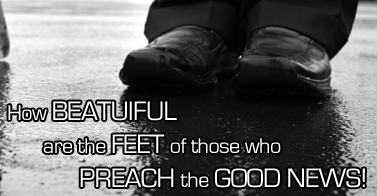
Through this brief little picture, God drove home to me the words of Romans 10:15b, “How beautiful are the feet of messengers who bring good news.” We are tempted to fall in love with personalities and to assume that saving power lies within persuasive sermons. Though I greatly value these men’s contributions to the kingdom, the power and beauty of Christ is found in taking the gospel to the unredeemed. If we are faithful to declare the truth of the gospel, we will have done just as much as John Piper could ever do for a lost soul.  Let’s be witnesses for Christ! “How then will they call on him in whom they have not believed? How will they believe in Him whom they have not heard? And how will they hear without a preacher?” (Rom. 10:14)