Peter Witkowski is the senior pastor of Amissville Baptist Church (ABC) located at the edge of the Blue Ridge mountains in Northern Virginia. Peter earned his Master of Divinity Degree from the Southern Baptist Theological Seminary in 2012. Seeking to put his theology into action, he became a certified member of the Association of Certified Biblical Counselors (ACBC) in 2016. Peter earned his PhD in historical theology at Midwestern Baptist Theological Seminary in 2023.
The calendar date escapes me but the memory replays vividly in my mind. As April and I headed to Charlottesville for her last chemotherapy appointment, my dear bride once more laid out her hopes for the future. She knew death lurked just around the corner. But she was not ready. She desperately longed to see our church mount the summit of self-sustaining health, to see me complete my doctorate, and to see our children come to faith. She was willing to relinquish the dream of shepherding her children into adulthood, but the rest remained nonnegotiable for her. Perhaps in a few more years, she would be ready to entrust her soul to eternity. But not now.
I openly doubted her conviction. She was such a planner and possessed such a love for others, I could not foresee her ever wanting to leave us. Even if she saw our three kiddos embrace Jesus and graduate high school, I know her heart would have longed to see them married and then establishing godly families of their own. She would have wanted to see our church accomplish this goal or that and watch me complete the next task God placed before me. Even at 45 or 50, she still would have had many a reason to keep on living. As the apostle Paul, she knew that to, “live is Christ (Phil 2:21).”
And so I slowly turned toward her, laid out my thinking, and then gently said, “I don’t think, you’ll ever be ready to leave us.” She smiled shyly and said, “I suppose you right.”
Can there ever be a good time to die?
The Inopportune Nature of Death
In one sense, the answer is no. No matter our age or season of life, death proves unnatural…an interruption of all that is good and right. While officiating the funeral of a dear man who passed in his 80s, I watched as one of his children stood up and tearfully noted that he had left too soon. She longed for a future that would still contain his funny stories and loving antics…things that had enriched his children and grandchildren’s lives for decades. As that day made clear, the human heart remains perpetually at odds with the idea of death.
Where God to come down from heaven in a whirlwind and ask us to name the time and location of our loved one’s death, I suspect none of us would be able to pick a point on the eternal timeline. We know only this world and that knowledge is woefully fragmented and incomplete. We do not see the eternal threads of consequence that make sense of all God’s actions and that make statements like “God works all things together for the good of those who love him,” true (Rom 8:28). Had April lived to be 49, 69, or even 89, I still would not have wanted to wake up in a world without her any more than I do today. As I tearfully told her that day in the car, “We are going to be miss so…so…very much. There is no good time to die.” In one sense, it truly is the greatest of evils.
The Gracious Nature of Death
Thankfully, the knowledge of eternity that we lack God possesses. Though we might be tempted to charge God with taking our loved one to soon whether that be the 1 day mark or the 100 year mark, God’s timing proves perfect. As Psalm 116:15 reminds us, the death of the righteous is precious to the Lord. God takes our loved one home at just the right moment. As Joseph Caryl wisely noted,
Whenever the godly die, it is harvest time with him; though in a natural capacity he be cut down while he is green, and cropped in the bid or blossom; yet in his spiritual capacity he never dies before he is ripe.
God never makes a mistake. He brings us home when he does because he loves both our loved one and us. Jesus delayed going to see Lazarus not only because he loved his friend but because he loved Mary and Martha as well (John 11:5). All things work together for good for both those in heaven and those on earth. No saint above will fault God for having brought them to heaven too soon. As Paul notes, “To dies is gain (Phil 1:21,23).
Why Christians Die
As much as I grieve the loss of my wife, I know she did not grieve her entrance into heaven. The end, the telos, of our existence is not a lifetime of free Starbucks, a winning lottery ticket, nor a fulfilling marriage. As C.S. Lewis noted in his essay the “Weight of Glory,” the very fact that men and women desire a utopia, a heaven, reveals that mankind was made for that eternal destination. To remain forever in the sorrows of earth lacking full access to God and surrounded by brokenness would prove a cruelty and not a mercy. I know a dear man decades my senior who has buried many a friend and family member. Though thankful for his long life, his face grows heavier with each passing year as his sorrows tied to pain and death continue to accumulate.
Where this life never to end, I suspect our sorrows would become insurmountable, and our salvation would remain incomplete R.C. Sproul helpfully noted,
Jesus bore all our sins on the cross. Yet none of us is free from sin in this life…The healing that is in the cross is real…But the fullness of healing from both sin and disease takes place in heaven. We still must die at our appointed times…There is no route to heaven except through this valley.
There is a reason God kicked Adam and Eve from the garden and barred them from the tree of life. An eternity marred by fallenness proves to be the very antithesis of the hope of the gospel. As our hunger for something better reveals, this world does not need to be preserved but remade. For the Christian, death becomes the means by which God ushers us into his presence and thereby satisfies our hunger for eternal goodness. The apostle Paul beautifully writes,
For while we are still in this tent, we groan, being burdened—not that we would be unclothed, but that we would be further clothed, so that what is mortal may be swallowed up by life (2 Cor. 5:4).
Just as Christ went from death to glory so to do all his children the moment their heart stops. To quote the apostle Paul again, “Death is swallowed up in victory. “O death, where is your victory? O death, where is your sting (1 Cor 15:54-55)?” Death ends in glory.
Good & Bad
So, can there ever be a good time to die? In one sense, no. I wish my April here with me today and forever. We were supposed to grow old together and have those rocking chairs on the front porch that she always talked of. We were supposed to raise a family together. But in the truest of senses, yes there is a good time to die…that perfect moment when God’s ushers our loved ones to their true end…their true purpose. And for my April, that day was June 25, 2022.
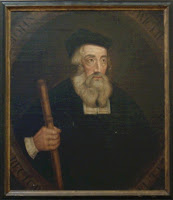
The group of dedicated and zealous church officials tossed the decaying skeleton into the newly lit fire with a sense of devotional glee. The men from Lincoln were carrying out the wishes of the Council of Constance which had declared that the scholar and theologian, “John Wyclif, was a notorious heretic, and that he died obstinate in his heresy; cursing alike him and his memory.” In perhaps one of the greatest ironic moments in history, the Catholic Church had Wycliff’s body which had lain peacefully in the ground since December 1384, exhumed burned, and then tossed into the River Swift in 1415 so as to erase his errors if not his very memory from the historical record. And yet as the presence of this discussion of him makes clear, Wycliff’s legacy and ideas continue to live on within the halls of church history and prove worthy of our examination. If for no other reason than curiosity, we cannot help but ask the question of: “What great evil must one do to warrant one’s bones being dug up, burnt, and then cast into a river?” What had Wyclif done?
From Oxford to Prague to Luther
To begin with, he had the misfortune of being associated with another heretic by the name of John Huss who arrived on the theological scene more than decade after Wyclif’s body have been entombed. While studying in Prague almost 700 miles away from Wyclif’s beloved Oxford, Huss came across Wyclif’s books while in the University of Prague’s library and would go on to attribute many of his theological beliefs to Wyclif. For example, when Huss discussed heresy, he borrowed Wyclif’s categories of, “simony, blasphemy, and apostacy.” Such citations did not enhance Wyclif’s legacy. The year before the Council of Constance condemned Wyclif’s body to be burned, it had ordered that John Huss be burned at the stake. What was Huss’s great crime?
Huss had proclaimed that salvation came not through sacraments such as the mass nor through the purchasing of indulgences but rather came when men and women adhered, “firmly and without wavering to the truth spoken of by God.” While defending the power of the gospel as revealed in the Bible, Huss rebuked priests for spending more time at the local bar than in their pulpits and took issue with the Pope when he countermanded the clear teaching of Scripture. As Huss noted,
If a pope’s command is at variance with Christ’s commands or counsel or tends to any hurt of the church, then he [a Christian] ought boldly to resist it lest he become a partaker in crime.
In many ways, Huss’s teaching should not have been controversial. Huss had hoped to peacefully reform the church, but the Catholic Church which had two popes at the time and enough scandals to set twitter ablaze for decades had no stomach for this biblical and rather a-political call for its local churches to be defined by pure doctrine derived from the Scriptures and by pure living. Thus, Huss found himself on trial in 1413 for his teaching.
The famed monk, Martin Luther, who started the reformation by nailing the 95 Theses to the door of the Wittenberg Chapel on Oct 31, 1517, would declare at his own trial in 1519 that, “I cannot believe that the Council of Constance would condemn these propositions of Huss.” But alas, it did. As the flames reached Huss’s head in 1414, he cried out “Lord, into thy hands I commend my spirit.” Huss’s body would be so thoroughly burnt that, “not a particle was left of body or garment that could be preserved and taken back to Bohemia to be used as a relic.”
How had Wyclif influenced Huss? Why was the British theologian deemed to be one of the most dangerous enemies of the Catholic Church?
John Wyclif
Wyclif had championed three theological positions that had encouraged Huss and earned the commendation of the Church. Wyclif proclaimed that simony or holding church office for the purpose of financial gain was sinful. Second, he proclaimed that the Church’s ultimate authority rested upon Scripture and not tradition. And lastly, he denied that the Eucharist or the Lord’s Supper was the physical body of Christ. All three positions (simony, Scripture, and sacraments) had emboldened Huss and indirectly Luther to follow Jesus and succeeded in irking the Catholic for generations to come.
Though Foxe portrayed Wyclif as a great organizer and visionary in his famous Foxe’s Book of Martyrs, the historical record revealed Wyclif to have been more of a reactionary as Martin Luther and John Huss would be in later years. Huss more stumbled into his position as a reformer than sought it out.
Wyclif was born in 1330’s in the town of Yorkshire to a family of limited nobility. With the help of some scholarships, he would go on to earn what would be the modern equivalent of his bachelor’s, master’s, and doctoral degrees at Oxford University where he earned the reputation of being an excellent lawyer, debater and scholar.
Simony and his Rise to Fame
In the 1360s and early 1370s, Wyclif came to prominence when the Duke of Lancaster asked Wyclif to help the English monarchy decide whether they must pay Papal taxes. England was in the middle of a war with France and could ill afford to allow the Catholic Church to take a share of its annual income. Though consulted more for his legal skill than his theological insight, Wyclif’s position on simony or of using the church as a for-profit business (think church greed) quickly became theological in nature. Wyclif affirmed that the church did not have to pay the pope if the pope had sinned. Diverging from Catholic doctrine which proclaimed, that the office made the man, Wyclif argued that the office’s authority depended upon the pope living a righteous life. As he noted in 1377,
No man ought to follow either pope, bishop, or angel but only insofar as he follows Christ, for Christ is both God and man.
If a man lived outside the bounds of Scripture, he ceased to exercise his church office, regardless of its prestige. Wyclif wrote, “Any act that loosens the bond of worship between man and the Father is sin against the Father. The pope, when he has broken by heresy the bond of divine service, is no longer apostolic but apostate.” Secular rulers were to disregard and pull the funding of any priest or pope who had besmirched the purity of the church. Even the threat of excommunication which resulted in one’s removal from the church and being condemned to hell carried no weight if the pope were in sin. Wyclif encouraged the nobles and kings to not fear, “the lightning bolts of excommunication in this case, because a curse resulting from this will be turned into a blessing.” As Wyclif noted, salvation depend upon faith in the providential work on the cross and not upon whims of the pope.
More importantly, Wyclif believed the very act of collecting taxes to support the secondary ministries of the church in ways that did not directly benefit local parishes and churches from which the money came was an act of simony or of church-based greed. According to Wyclif, Jesus had called the church and its officers to collect only those funds needed to support gospel ministry. As Wyclif said, “it is appropriate that he [the priest] duly feed his body sparingly and moderately.” But the money collected to support monasteries or other civic functions of the church were sinful. He also strongly condemned friars, medieval – traveling preachers whom Wyclif called “a pack of apes,”- and anyone else who directly exchanged gospel ministries such as prayer, the appointment of church officials, or the sacraments for money. He wrote,
When someone in exchange for money performs a service or ministers in an office in which the Holy Spirit is conferred, he not only makes money his god, but sacrifices both persons to the idol that he adores.
He similarly took issue with indulgences, the idea that people could purchase their salvation or sanctification, declaring, “that priests granting indulgences commonly blaspheme…God’s wisdom.” Grace freely bestowed by God resolved the complexities of human sin apart from payment. To quote Wyclif once more, “It is clear that a viator [traveler] can take it that his sin is destroyed or that he is contrite in soul only through hope in the mercy of Jesus Christ, a marked sorrow and a holy life.” Salvation came through belief in the life, death, and resurrection of Jesus. To quote the theologian, “A right-looking of full belief on Christ saves His people.”
The only remedy for the greed, “the leprosy,” that consumed the church of Wyclif’s day was for, the “Lord pope, bishops, all religious Lords, simple clerics endowed with…possessions…to renounce these possessions into the hands of the secular arm of the church, and if they stubbornly refuse, they should be forced to do so by secular lords.” Wyclif believed the king had a moral and biblical duty to resist any pope who stole from his parishioners. Those kings that refused to protect the spiritual quality of their nations would endure an even worse punishment than the sinful church officials. The church was to instruct the state and the state was to preserve the church.
While this understanding of church-state relationships would understandably trouble modern readers who believe the church and state should be separate entities, they also troubled Wyclif’s contemporaries. The Catholic Church thought herself above the state and disliked the idea of church-state cooperation.
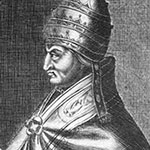
In 1377, Pope Gregory XI issued Papal Bulls or decrees condemning Wyclif’s teaching. One of the Pope’s letters went to Oxford and another to the King. While not necessarily in favor of Wyclif’s ideas, Oxford refused to act, seeking to prove itself independent of papal authority. The king at the time was twelve years old and highly influenced by his Queen Mother and the Duke of Lancaster, Wyclif’s protector, John Gaunt who also took no action. But in 1377, Wyclif had to defend his ideas before a tribunal of Bishops at the chapel in Lambeth, England. That tribunal condemned Wyclif’s ideas as heretical and forbad Wyclif and others from teaching his ideas. But nothing much came of this decision for Gregory XI died in 1378 and then two different men claimed to be pope which brought the administrative wheels of the church to a temporary halt.
The Sufficiency of Scripture
As the screws of persecution began to tighten around him, Wyclif increasingly turned to the Scriptures for wisdom. As he wrote in 1384,
Scripture is the foundation of every Catholic opinion and within it resides the very salvation of the faithful.
As Wyclif read and study God’s Word, he became convinced of the authority of the Scriptures. He boldly asserted that, “the certitude and authority of Scripture should be given preference over human reason…since Holy Scripture is the word of the Lord and thus must be of the highest authority.” Scripture could be trusted for it was “true in all of its parts according to its intended sense.” For any doctrine or idea to be believed, it had not only to align with church practice but with the clear and authoritative teachings of Scripture. To quote Wyclif,
It is lawful for bishops and vicars of Christ to formulate statutes designed to help the church…they ought to be accepted, unless they…prove contrary to Holy Scripture.
He continued, “To say…that all papal bulls are of equal authority or certainty with truth with Holy Scripture would be blasphemous attributing to pope the claim of being the Christ.” Christ alone was the Word of truth as contained in the Scriptures. And the Word was the final authority. Wyclif concluded, “Holy Scripture exceeds all human canons in usefulness, authority, and subtley.”
Lollards & the Wyclif Bible
Since the Scriptures were true, understandable and authoritative, Wyclif placed great priority upon the preaching of the Word. Wyclif concluded, “the right preaching of God’s Word is the most worthy work a priest may do among men…more fruit comes from good preaching than from any other work.” Faithful preaching would reflect the clear teaching of the Scriptures and would lead people to salvation and holiness. To quote Wyclif, “God does not ask for cleverness or rhymes from one whose duty it is to preach, but simply to explain rightly God’s Gospel and his words, to stir his people thereby.” Though the Reformation term of Sola Scriptura or Scripture Alone would not appear for a few hundred more years, the concept proved to be a fixture of Wyclif’s theology.
Given Wyclif’s high view of preaching, his name became readily associated with the Lollard movement, a movement of lay preachers devoted to the gospel. While the extent of Wyclif’s involvement in the movement remains debated, historians fully affirm both Wyclif’s high view of the Scriptures and of preaching. As Wyclif noted in his pastoral handbook, “the best life for a priest is a holy life keeping the commands of God through faithfully preaching the gospel, as Christ did and charged all his priest to do likewise.” Even if he did not create the Lollard movement, his teachings inspired the lay men who traveled about England preaching the gospel.
Similarly, the extent of Wyclif’s involvement in the English translation of the Bible remains a topic of debate given the fact that John Purvey the main editor of the Bible makes no mention of Wyclif’s influence upon the project. But historians do not doubt that Wyclif wanted the common people to have the Bible in their own tongue. As he said in 1384, “the knowledge of God’s word should be taught in the language known to the people, for God’s Word is essential knowledge.” Commenting on Pentecost, he concluded,
God willed that the people were taught his Word in diverse tongues; therefore, what man acting on God’s behalf would reverse God’s ordinance and his revealed will?
Those who only allowed the Bible to be translated into Latin and who restricted lay people from reading the gospels went against God’s will. Though Wyclif understood that English translations would need to be constantly updated, he believed such translations would empower people to follow God’s law and would prevent the church from falling into heresy. If they lay people could read the Scriptures, they could hold their clergy accountable. While the extent of his involvement in the Lollard preaching movement and in the translation of the Bible that bears his name are debated, his support of such ideas can be easily found in his writings. As Steve Lawson noted, Scripture was, “the vital heartbeat of Wyclif’s ministry.”
Understandably, the church which claimed to have the exclusive right to both teach and interpret the Scriptures took issue with Wyclif’s ideas.
Sacraments & Trouble
In 1381, he found himself called before another council for his teaching on the church, the Scriptures, and lastly the Eucharist or the Sacrament of the Lord’s Supper.
In 1215 at the Fourth Lateran Council, the Catholic Church had declared that when the priest prays over the elements of the Lord’s Supper, the bread and the wine become the physical body of Christ. By consuming the bread and wine, Christians ate Jesus and gained additional strength to fight sin. After studying the Scriptures and the early church fathers, Wyclif concluded that such a theory was unbiblical. He wrote,
We ought to believe not that it is itself the body of Christ, but that the body of Christ is sacramentally concealed in it…The spiritual receiving of the body of Christ consists not in bodily receiving, chewing, or touching of the consecrated host, but in the feeding of the soul out of the fruitful faith according to which our spirit is nourished in the Lord…nothing is more horrible than the necessity of eating the flesh carnally and of drinking the blood carnally of a man [Jesus Christ] loved so dearly.
While such a move might seem insignificant, it proved significant for Wyclif for he had openly written against a rather standard and well-known doctrine of the fourteenth century church.
In May 1382 at the Black friars Synod, Oxford condemned Wyclif’s teachings and forbade him or anyone else from teaching any of Wyclif’s ideas. Facing house arrest as well, Wyclif appealed to the king for help. John Gaunt arrived and kept Wyclif out of prison but also showed him the necessity of resigning from Oxford. Given the young king’s precarious position, the crown could not afford a long and protracted battle with Oxford or the Catholic Church. Thus, Wyclif moved to Lutterworth to live out his days writing about the Scriptures and sharing the gospel he loved so dearly. He died from a stroke on December 31, 1384, at (most probably) the age of 54.
Final Thoughts
As the catholic officials digging up his tomb made clear, Wyclif’s ideas did not die with him. The man who called priest to repent of simony or greed, who championed the authority of the Scriptures, and who advocated for a scriptural understanding of the Sacrament of the Lord’s Supper will in once since never die. For what made Wyclif famous was not his ingenuity but his foundation, the gospel of Jesus Christ. What God promised Isaiah in 55:11 would prove true of Wyclif,
“My word…that goes out form my mouth; it shall not return to me empty, but it shall accomplish that which I purpose, and shall succeed in the thing for which I sent it.”
God’s word continued on from Wyclif to Huss to Luther and then to millions of us today. No one can stamp out the Word of God or those who stand with it. Even if they burn our bodies and toss our ashes into the sea, the God’s Word abideth still.
Ten years ago, I approached this day with nervous trepidation. I had never lived with a woman as husband and wife. I fully anticipated that my future with April would be glorious. But I had no clue what my life was about to become.
Turns out all the nerves that got me up and dressed by 5AM on October 20, 2012 were justified in the same way this grade school boy once rightly burst with enthusiasm the morning before his first game at Wrigley Field. But what I experienced these past nine plus years defied even my expectations of what could be.
As we turned the corner into the wedding chapel’s back annex, I kissed my purplely person for the second time and felt pure happiness. All was well with me. I was her husband, and she was my bride. We went on to kiss so much those first few days that we practically rubbed her chin raw. Oh, to love and be loved.
The Last 9+ Years
The sweetness of that first week translated into a lifetime of joy. I got the awesome privilege of watching my bride go from being the girl who put chili powder on our cinnamon toast to one of the best cooks I know. She mastered the skill of chopping fresh vegetables, of making log cakes and of crafting her own recipes not from personal interest per se but from love. Truth be told, she hated to eat and always found the consumption of food to be a chore. But she loved caring for me and our kids and found joy in living out the command to be hospitable. The girl who once thought her home should be a castle helped me see that our home needed not to be a fortress but an oasis for the weary and heavy laden…our brothers and sisters in Christ.
As she grew, we grew. She proved to be my greatest spiritual companion these last years. On the inside of our wedding rings were inscribed the words, “sanctification buddy.” She fulfilled that promise. I benefited greatly from her insights into theology as we talked through the Scriptures that we were memorizing together and hashed out my sermon texts both before and after the service. During those early years of ministry, we also learned together the importance of placing our trust in the Lord as opposed to our feelings. We were the worst of prophets.
Though she possessed a gifted mind that made her a great counselor, her faith was not academic. She patiently bore with my insecurities and failures, extending mercy and forgiveness when I sinned against her. And long before anyone else, she encouraged me to be a senior pastor. She cheered me on through every difficult season of study and church reform resolutely saying, “I don’t know why you worry; I always knew you could do it. I never doubted you.” She had a resolve when it came to her theology and to living out that theology and yet a sweet spirit of submission and charity. She delighted in being my sanctification buddy and I hers.
And she could pray. When she wrestled through her own failures, doubts, and sorrows, she cast her cares on the Lord, trusting him to care for her. She pleaded with God to grow our church, to heal her body, and to save our children.
As the prayers recorded in her journals evidence, my dear April was also the best of moms. She delighted in her children even when they were spilling food, writing on the walls, and throwing up all at the same time. And as she cooked, cleaned, and homeschooled our three children, she took note of their special personalities and delighted in encouraging Lacey’s passion for music, Lily’s love of board games and puzzles, and Luke’s passion for basketball. I loved parenting with her and hearing her joyfully recount all that she and the kids had done.
I also had the privilege of helping her understand that its ok for boys to bleed and that winning a three-hour sit-in with your three-year-old does produce huge long-term benefits. And she showed me how to slowly lean into a hug from a lonely four-year-old and how to patiently delight in a six-year-old’s silly story performed on a makeshift stage. We made a great team.
Perhaps most importantly of all, she was fiercely loyal to me. I was hers. As she would tell me often, “Peter, I chose you.” She was no man’s captive. She dated me, married me, and stayed with me because her heart overflowed with love for me. She sacrificed for me at every turn, allowing me to get my counseling certification, to pursue my PhD, and to serve as a senior pastor. One of her last prayers consisted of a request that God would bless me with a happy PhD graduation. She endured the hardships of ministry gracefully and embraced having to walk through seasons where she functioned as a single parent. She never once resented me for having to visit this person or attend that meeting. If anything, she spent those lonely and exhausting hours praying for me, our children, and our church family. About a month before she died, I knew things were on the brink of disaster because a church emergency arose and for the first time in our marriage, she asked me to stay.
Even as her breast cancer began to get the upper hand, she pressed forward because of her love for me. She did not want me to suffer the piercing loneliness that I now know all too well. In many ways, she anticipated far better than I the sorrow that was about to crash over me and did all in her power to protect me. She was an amazing woman. She loved me. Oh, what a joy it was to come home to her, to talk with her, to be with her. As I told her often, the only thing I wish I had done differently in our courtship was marry her sooner. Oh, to have loved and been loved by April Gentry Witkowski.
What Now?
And now ten years later… my sanctification buddy is gone. Our marriage is over. There are no cards to write nor dates to plan. Once again, I find my heart on an October 20th filled with nervous trepidation. I have no clue what tomorrow will bring and cannot predict what form God’s deliverance will take. As I noted before, I am neither a prophet nor the son of a prophet. And while I struggle to wait patiently upon the Lord, I face the daunting task of trying to make sense of this day that meant something so very different just a few short months ago.
How does one both appreciate what was and push forward towards what could be? What does one do with what was once his anniversary?
In one of her journals a few months back, my dear April penned these gracious words:
I can’t express…how much my marriage means to me. Peter is more than a best friend or partner; he is the one whom my soul loves. He is the one I always want to be with. I never grow tired of talking to him…You gave me the exact husband that I always prayed for. Thank you! Thank you for giving me something so great!
I suspect that I will never fully know what to do with October 20th. But I know where to begin. I will follow the lead of my dear wife one last time and thank our heavenly father for what was. Or to quote my dear April, “Thank you for giving me something so great!”


 Witkowski Blog