
 Sargeant, Anna. The Big Picture Interactive 52-Week Bible Story Devotional. B&H Publishing Group, Nashville, 2016. pp224. $13.49

And now Lifeway has released its first Gospel Project devotional for kids called, The Big Picture Interactive 52-Week Bible Story Devotional For Kids. Although the title is not too catchy, the content is! If you are looking for a great devotional for grade school kids that will connect them to the story of Jesus, then this is the devotional for you!
How It Works
As the title suggests, the devotion is divided into 52 weeks. Each week stars with a one page devotion filled with application from a Bible story such as creation, the ten commandments, or the parable of the sower. The next page contains a colorful picture that your kids might recognize from Sunday school with a brief summary of the story underneath it.
Turn the page, and you come across a whole host of additional information. There is a “Read It” section, containing verses that show how the principles of the story appear all over the Bible. Underneath the “Read It” section, the “Christ Connection” shows how the story fits into the entire gospel narrative. Also a QR code on the page links you to the Gospel Project Sunday School video that creatively recounts the Bible story you just read.
On the next page over there are three sections: “Live Big.,” “Big Picture Questions,” and “Dear God.” The “Live Big” section is full of great ideas that will help your kids apply scriptures. The activities include everything from planting seeds, to praying for the lost, to getting your family to do a trust fall (You might want dad for that one). The “Big Picture Questions” help kids apply the lesson to their own lives, by challenging them to think about whether they would obey God or cheat on a test. Would they be willing to love the bully next door? Lastly, each devotion ends with a “Dear God” section. It is a prayer designed to show the kids how they can ask God to equip them for every good work in light of what they have just studied.
How you go through the material is up to you. You could do it in a day, a few days, or stretch it out over the whole week. Regardless of how you do it, this devotion brings the truths of the Bible into your kids’ lives through stories, Bible reading, videos, activities, discussions, and prayers. With so many resources at their disposal, parents should be able to connect their kids to the gospel.
What To Like:
Of all the kid’s devotionals I’ve come across, this is one of the best because it faithfully teaches Jesus in a kid friendly manner. It helps kids to see that salvation comes through Christ alone through faith alone. And then it helps them to understand what it means to be a Christian in real life. Because the devotion covers the full scope of the biblical narrative, it touches on a ton of relevant topics for kids and their families. It talks about death, suffering, how to fight the urge to work our way to heaven, how to overcome the fear of man, and much more. In short, the devotion hits on a ton of the issues of that kids struggles with day in and day out. And as families work through the stories and illustrations, they will learn that God’s word is relevant for their lives and hopefully grow in their faith.
What Not To Like:
Although, the devotion does many things well, it has a few draw backs. First, there are no 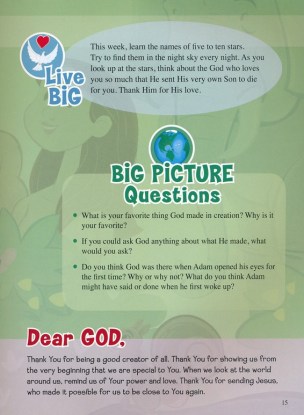 direct scripture references. Although the devotions are filled with supporting scriptures, the reader is never told where the Bible stories come from. I feel that having the scripture references printed somewhere in the devotional would help the kids and parents grasp that the stories are historical. Second, a few of the devotions such as the one about Zacharias and the one on Samson, assume that the reader already knows the story (p.76, 122). The “Hear It” section does offer a short explanation of the story. But I could easily see a reader doing these devotions and not gaining a full understanding of that particular biblical text. And lastly, some of the devotions focus on secondary points of application. For example when talking about Samson on page 76, the devotion says we need to trust that God is always working. And while this is true conclusion, I think the main point of Samson’s story is that Samson shows our need for Jesus, the true deliver. And thankfully, the “Christ Connection” says just that. “Jesus would come as the last Deliverer, saving through His life and His death those who would trust in him” (p.78). Sometimes, I wish the “Christ Connection” was the devotion. But at the end of the day, these are all minor concerns. Anna has done a great job of walking people through the Bible in 52 lessons. This was not an easy task.
Final Thoughts
Like all of the other Gospel Project for Kids materials to date, the 52-week devotional does not disappoint. It is a great resource for families with grade schoolers. The devotions are filled with illustrations that most every kid can relate to. (Using the stories of Corrie Ten Boom and Martin Luther King to explain the gospel is an added plus). Moreover, the “Live Big” and “Big Picture Questions” sections show kids how to insert the gospel into their lives. How great would it be if every kid applied the scriptures by praying for their lost cousins, by doing the dishes, and by getting the bully at school a birthday present? If you are looking for a devotional that will help your young family understand and apply the narratives of the Bible, get this new devotional.
And if your church is like mine and currently uses the Gospel Project Curriculum, this devotional will be an even bigger blessing. It will enable you to work in tandem with your church I will allow your church to reinforce your family worship time.
Are you ready to get copy of the 52 Week Bible Story Devotional?
For More Book Reviews Click Here
 gress, felt this way. He desperately wanted to come to Jesus, but he did not feel that God wanted him. He knew that he was a great sinner. He knew he deserved hell. And he knew the gospel. But he felt that God would not accept him. He felt that he had not been called. Oh the horror of wanting God and yet not being able to get to him. You could almost hear John saying, “Curse those stink’n Calvinist and their doctrines of God’s sovereignty.”
 f someone is under conviction, if they desperately want to repent, if they are eager to embrace and to follow God, all they have to do is come. The Holy Spirit never convicts someone only to leave them languishing in hopelessness. God never dials the wrong number. When He calls someone, he will save them. There is not one person in the Bible who desired to be right with God and was rejected. Everyone from Adam on who wanted to believe in God did. As Jesus said in John 6:40 “For this is the will of my Father, that everyone who looks on the Son and believes in him should have eternal life, and I will raise him up on the last day.”
 naturally, we want our kids to have good friends too. At their best, childhood friends are buddies, encouragers, and fellow enthusiasts who create bonds that last a lifetime. As Ecclesiastes 4:9 says, “Two are better than one because they have a good return for their labor.” But at their worst, childhood companions are drama queens, bullies, and liars that bring a steady stream of misery into our families.
 Witkowski Blog