The Summertime Gospel

V…B…S…V…B…S…V…B…S

Summer Time GospelHundreds of kids running around downing Jell-O incased gold fish is just one of the many things that make Vacation Bible School one of the craziest but most exciting events on the church calendar.  As the week of crafts, games, and singing unfolds, Christian parents and youth have the chance to pour the gospel directly into the heart of kids. But as with all good church programs, Christians must actively work to keep VBS focused on preaching the gospel of the kingdom of God.  

The Purpose Of VBS  

Several VBS publishers have begun to tailor their programs to church kids. These curriculums emphasize God’s love, obeying parents, or caring for schoolmates. They want kids to bounce out of the closing ceremony with a better understanding of how to be good Christian.

Though well intended, the move to make VBS into a summer camp-style-refresher course on the merits of moral living is not the best use of church resources. The people of God are called to be evangelistic. We are to follow Christ and proclaim the gospel of the kingdom of God (Mark 1:14-15). Our goal should not be to turn outreach programs into members’ only ministries. Not too long ago, the evangelical church redid Sunday school, changing it from a program designed to reach poor, inner-city kids into a muffin filled fellowship time for adults. Now I don’t think adult fellowship times are evil. But we must be careful not to become so focused on meeting our own needs that we close our eyes those outside our walls. One program that traditionally has had an outside focus is VBS. Let’s keep it focused on the Great Commission by inviting the community to attend.

Logo-GirlThough reaching the community is hugely important, an effective VBS also needs a message that connects to those outside the church. If we call unsaved kids to be good without offering them the power of the gospel, we will confuse them in one of two ways.  Either they will leave depressed because they cannot be meet the impossible standards of Jesus or they’ll leave a VBS t-shirt wearing Pharisee, who is convinced they can conquer sin through sheer will power. Let’s not leave kids hopeless or help them cover up their sin nature with some spiritual self-esteem. Let’s faithfully proclaim the gospel, trusting that God will work mightily!  

Now when it comes to preaching the gospel this summer, we do not need to restrict it to an emotional display that climaxes with a pastor passionately asking kids to accept Jesus because “He will make everything better!” After all, who wouldn’t sign up for their best life now by repeating the short phrases of a sinners’ prayer?  

               A better option is to make all of VBS be about the gospel. We should choose curriculums or create programs that help the kids singing in our pews to understand the depths of their sin. Then, we direct these energetic souls to Christ who has paid for their sin. We offer them the hope of eternal life while reminding them that to gain true life they must abandon their self-centeredness.  Jesus said, “If anyone would come after me, let him deny himself and take up his cross daily and follow me.  For whoever would save his life will lose it, but whoever loses his life for my sake will save it” (Luke 9:23-24).

What About The Church Kids?

Now some might be concerned that a VBS focused on the gospel might fail to connect with the church kids. First, we need to remember that our good church kids might not be saved. They could be all about the nice things in life because they hope their mission’s offerings and Sunday school attendance will get them into heaven. Second, we need to remember that our goal is not to help kids pretend that they don’t need a savior. Even saved children still need to be reminded of the cross and of their need to depend on Christ alone as the live they Christian life.  “The cure for kids who feel burdened by sin is not to ignore the topic (they feel the burden anyway, even if that aren’t talking about it), but to administer large doses of the good news so that their faith Jesus grows” (Klumpenhower, p. 39). The gospel is relevant for every kid regardless of how many times they went to Sunday school.   

This summer, let’s make the VBS all about the gospel!

Works Cited

Show Them Jesus: Teaching the Gospel To Kids. Klumpenhower, J. (2014)Greensboro : New Growth Press .

Preaching To Little People

SalvationSeries_LittlePeople_3God Saves Little People 

The precious little people that made up our kids church were bouncing through doorways, scooting under pin pong tables, and ducking around railings. As I tried to herd our cookie infused kids towards their parents, a lady pulled me aside to tell me that her grandson was ready for baptism. I was a completely caught off guard.

Her grandson was a pleasant, little guy. But he was at best a casual church attender with a shaky knowledge of the gospel, and a passion for M17 video games. Over the course of the next few weeks, the church’s pastor and I discovered that this grandmother was not motivated by a low view of baptism. She was driven by a heavy burden of spiritual responsibility.

               She (like many other Christian parents and grandparents) loved her grandson. Being the main Christian influence in his life, the grandmother brought her grandson to church every chance she got.  At some point, she had assumed the responsibility for her grandson’s salvation. Now, she wanted to get him baptized in an effort to get him eternal life. But the great news is that we as parents and grandparents are not responsible for saving our little people. We can’t and we are not supposed to. God saves! As parents and grandparents, we are called to preach the gospel to little people through our life and words. This is a task is a task we can do with the Lord’s help!  

Walking For Little People 

               Before we begin plopping little people down in plastic pews, we have to walk with Jesus. In Deuteronomy 6, we read that we are to, “careful to do” all the commands of God so that it “may go well with you” (Deut. 6:3). Jesus reiterated this command in John 12:26a saying, “If anyone serves me, he must follow me; and where I am there will my servant be also.” If we want our children to follow Christ, we must walk with Christ day in and day out. We need to let the Word of God drive our actions at home, at work, at night, in the morning, and at every point of our life. Every aspect of our lives need to daily reflect transforming power of the cross.

If we don’t, our little people will know. In addition to being candy lovers, our children are also gifted hypocrisy detectors. They may not say it (because quite frankly most two-year-olds have yet to add hypocrite to their vocabulary), but they know when our actions deny our words. If family worship is a prayer during a commercial timeout of the final four, our little people know that you love Georgia Bulldogs or more than gospel.

And when we mess up by skipping a family devotion to watch the last episode of The Bachelor or by angrily snapping at our son when he interrupts our game of angry birds, we can still use the situation to proclaim Christ. There is no stronger testimony of the gospel to a child than of a parent humbling asking forgiveness and repenting from of a sin. By humbling ourselves, we show out little people that the power of Christ is real and brings about real life change (I Peter 2:24). Let’s walk in truth.  

Preaching The Gospel To Little People

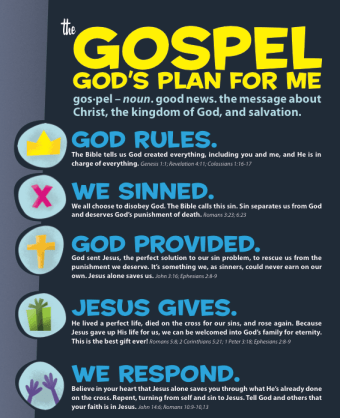
               But walking is not enough; we also need to preach truth to our little people. Gospel-Gods-Plan-for-Me-poster-thumbnailAccording to Ephesians 6:4, we are told to raise our children in the discipline and admonition of the Lord. We have the awesome opportunity to teach the gospel to our babies, preschoolers, and oh so cool middle schoolers. So what do we say? We preach the story of the Bible, namely that:

  1.  God is the good, all-powerful, and just creator of the universe, existing as one God in three persons. Duet. 4:35; Ps 47:7-8; Col. 1:16-17; Matt. 28:19.
  2. Adam and Eve sinned bringing death and suffering into the world. Because of sin, we now are all sinners deserving of death because we have all sinned. Gen 3:1-7; Rom. 5:12-21; Rom. 3:23.
  3. Christ came to save us from our sins by living a perfect life, dying on the cross, and rising from the dead. Heb. 4:15; I Peter 3:18; I Peter 1:3-5; I Cor. 15:1-9.
  4. Repent of your sins and trust Christ as your Lord and savior. John 3:16; John 3:36; Rom. 10:9; Act 2:38.
  5. Put on the new man created in Christ Jesus. Eph. 4:24; Col. 3:10; Matt. 3:8; 2 Cor. 5:17.

If you are looking for some more gospel resources to help you understand how to reach your kids with the gospel, I highly recommend:

  1. The Gospel in Context PowerPoint presentation by One-Eighty Counseling & Education 
  2. Appendix A of The Faithful Parent by Dr. Stuart Scott
  3. The Gospel Plan For Me a Lifeway tract
  4. Big Truths For Young Hearts by Dr. Bruce Ware

Getting Down With The Little People

Now practically, we do not need to have “organized” clinical gospel sessions with our kids. Yes, we should embrace some form of family worship where we can work through the gospel together as a family by reading through scripture and/or devotional materials. But, gospel proclamation is not limited to the family room. As Moses makes clear in Deuteronomy six, we are to instruct our children in righteousness on the baseball diamond, on the floor of the den as you wrestle, and when you tuck your little gal into bed. We are to see every life circumstance as having the potential to lead to a spiritual conversation. Preach the gospel!

The Little People Results

By laying a foundation of gospel proclamation, we get the amazing privilege of playing an instrumental role in our child’s spiritual life. Faith comes through hearing (Rom 10:17). If we faithfully proclaim the gospel with our words and actions, it’s very possible that we as parents will get to lead our children to Christ. Again, this is what Moses anticipates in Deuteronomy 6:20. He anticipates that little people will to turn to their parents for guidance about reaching eternity.

No Magic Pill For Little People

Now unfortunately the steps listed above are not a magic pill. Just as baptism could not SalvationSeries_BaptismClassforParents3ensure the salvation of the grandson mentioned earlier, faithful walking and preaching to a little one does not guarantee their salvation. The spiritual world is not an adding machine. “As John MacArthur writes:

…equipping a child with spiritual truth is no guarantee he or she will follow Christ. I know many diligent parents and grandparents whose hearts have been broken by a family member’s rejection of Christ. We can only plant the seeds by teaching and living out the truth. How they respond is out of our hands.” (Fitzpatrick, Newheiser, & Hendrickson, p. 27)

All of our little guys and gals are sinners born with sin blackened hearts. God must save them just as he saved us. And the Holy Spirit is like the wind, refusing to be manipulated by well-meaning parents and grandparents (John 3:8). But here is the good news. We are not called to save little people. We are called to point them to Christ. This we can do. And until the day we see our little people express and demonstrate faith in the one true God, I invite you to join me in fervently praying for their salvation!

Questions For Reflection

  1. I am living the Christian life well? Are there things such as money, pleasure, sports, shopping etc. that come before Christ?
  2. Have you asked your spouse and children to honestly evaluate your life?
  3. Are the sins you need to repent of and patterns that you need to change? What are they?
  4. Do you have family devotions? Do you preach the gospel to your little people?

Recommend Books

Fitzpatrick, E., Newheiser, J., & Hendrickson, D. L. (2001). When Good Kids Make Bad Choices. Eugene: Harvest House Publishers .

Martha Peace, S. W. (2001). The Faithful Parent: A Biblical Guide to Raising A Family . Philipsberg: R&R Publishing .

Ware, B. A. (2009). Big Truths For Young Hearts: Teaching and Learning the Greatness of God . Wheaton: Crossway.

From YMCA to Veggie Tales: Children’s Ministries That Last

Blog_YMCA to Veggie TalesJust like its namesake song, the YMCA is quickly becoming classic of a bye gone era. The Christian gyms famously devoted to reaching young men are being replaced with Veggie Tale concerts, Winshape Camps, and a wild assortment of other pubescent activities. Every day churches are updating nursery facilities, hiring children’s pastors, and launching new kids’ programs. Children’s ministry is the new youth ministry. And in many ways the focus upon children’s ministry is a good thing. According to Ken Ham, some forty percent of those who leave the church decide to check-out during their elementary or middle school years.[i] We need to do a better job of reaching our children for Christ. But before we hire a themer or create the hottest new curriculum, we need to ask ourselves what is the goal of children’s ministry?

According to scripture, the twelve and under program should consist of the following three headliners: the gospel, parents, and discipleship.  Before we can look at putting together an A-list children’s ministry, we first need to understand our audience.

In the Psalms, we discover that all babies enter the world infected with sin.  According to the Psalmist, “The wicked are estranged from the womb; they go astray from birth, speaking lies” (Ps 58:3). The teaching that all children are born with “iniquity” is reinforced in Psalm 51:5 and in Romans 3:23. Reflecting upon these and other passages, the famed theologian J.C. Ryle commented, “one thing a mother can say with certainty: [her infant] will have a corrupt heart.”[ii] Similarly, Elyse Fitzpatrick and Jim Newheiser wrote,

“Children are not good by nature; they are not a “blank slate” upon which we can write our values; they are not inherently innocent, nor are they genetically predisposed to be good. In fact, the Bible teaches that they are genetically predisposed to be bad because every child is born with original sin and a rebellious nature.”[iii]

All babies and infants (and I would argue a majority of preschoolers, elementary students, and middle schoolers, “the intention of man’s heart is evil from his youth.” Gen. 8:21) first encounter children’s ministry as an unbeliever with little to no knowledge of the gospel. What do we do with these precious little ones?

First, we introduce them to the gospel! According to Deuteronomy 6:1-25, we are to teach our uniformed, little sinners the word of God through Sunday school lessons and through our actions. We do so hoping that the Holy Spirit will spark questions in the hearts of our children that will burst into the glorious flame of salvation. As Paul says, the law is the tutor, the teacher, by which we come to Christ (Gal. 3:24). Before we bring out Lottie Moon or anything else, let’s expose our children to this firm yet wonderful teacher.

Secondly, we need to welcome parents onto the children’s ministry stage. In Deuteronomy, Moses charges parents with the primary responsibility of reaching their children for Christ.  We are told that children will ask parents (not pastors or Sunday school teachers) about spiritual matters. Consequently, I believe equipping parents to disciple their own children is one of a children’s ministry leader’s most important tasks. As I look back over my time in children’s ministry, I have seen ample evidence of this truth. The number of children who came to Christ while interacting with their parents far out paces the number of professions made at camps or vacation bible schools.  Not surprisingly, every child that I have counseled has come to my office accompanied by a loving parent who has been fielding their child’s spiritual questions.  Let’s strive to equip our parents to bring up their children “in the discipline and instruction of the Lord” (Eph 6:4b). During the next few weeks, I look forward to tackling the subject of “leading your child to Christ” in more detail.

Although parents our charged with caring for their children’s spiritual formation, their calling does not negate the importance of the church. Psalm 78 reveals that teaching the next generation also contains a corporate element that extends beyond the immediate family dynamic. As J.C. Ryle notes, “Few can be found, I think, who might not influence some parent in the management of his family, or affect the training of some child by suggestion or advice.”[iv] When we have children in our homes, or in Sunday school rooms, or in Wacky Wednesday gyms, we should remember Deuteronomy 6, Psalm 78, and Ephesians 6. We are to partner with parents by diligently teaching all children the gospel story in a loving, engaging manner. “Both [the family and the church] have been given the task to disciple young people.”[v]

Thirdly, we introduce these warmed up crowds of little people to discipleship. Regardless of our audience’s age, we are called to make disciples not converts (Mathew 28). Consequently, we should make truth for growth a valued member of our gospel focused, children’s ministries. We should teach on Ephesians 6, encouraging our children to obey their parents. We should teach young Christians to put on the “tender mercies, kindness, long suffering” of Colossians 3. But, we must do so in a manner that also recognizes many of our listeners lack regenerated hearts and gospel knowledge. As children’s pastors, teachers and workers, we must remind all the souls under our influence that the Christian life is impossible without Christ. We must constantly show our children their sin and then introduce them to the Jesus who saves and transforms all who call upon his name.

Who knows if Veggies Tales will become a heralded classic or if the cute vegetables will return to forgotten produce isle? But this we do know. The word of God will never pass away (Mat 5:18). If we faithfully build our children’s ministries on the Bible by proclaiming the gospel, equipping parents, and on discipling children, we will escape the bounds of irrelevance.


[i] (Ham, Beemer and Hillard 2012,) Ken Ham also points out that another 50% of those who leave church decide to do so during high school. I wish in no way question the validity of youth ministry as it has a special place in my heart. I came to Christ under the preaching of a faithful youth pastor. I only wish to point out that the enthusiasm of yester year that went into youth ministry has now been redirected towards children.