 The COVID-19 shock-wave that turned the United States upside down knocked more than one pastor out of his pulpit. With the help of Facebook Live, Youtube, and lesser known platforms, ministers have begun to regain their footing, launching online services. As pastors have started “going live” they have also begun to criticize their sheep who fail to watch their the latest sermon or who watch that sermon irreverently. Pastors who a few weeks ago challenged the legitimacy of the Facebook users’ faith are now employing Facebook to question the faith of those who do not use Facebook enough.
Irony aside, the pastors’ complaint raise a foundational question: What is a church? Is the online service truly a church service? Do those members who fail to watch their pastor online break the commandment of Hebrews 10:25 and forsake the assembling of the church?
What is a Church?
A quick overview of the New Testament reveals that online church services cannot be equated with the typically weekly gathering of the church. Though the definition of the church can be expanded to cover pages as Dr. Greg Allison has done, it can also be reduced to two basic elements: the right preaching of the Word, and the proper administration of the sacraments. For a group of people to rightfully claim to be a church, they must meet regularly to preach the gospel, to administer the Lord’s table, and to perform baptisms.
Can people meaningfully do these things when they are not physically meeting together?
The Scriptures say no. When Paul wrote to the Corinthian church, he expected them to meet together as an assembled group of believers. He encouraged “the assembled” church to practice discipline, to rightly administer the Lord’s table, and to correctly employ tongues and biblical teaching (1 Cor. 5:4-5; 1 Cor. 11:18; 1 Cor. 14:23). The phrase, “When you are assembled” was the lens through which Paul shaped the church. When Christ spoke of the church, he too defined it as consisting of two to three people who physically gathered together to worship and to practice church discipline (Matt 16;18).
To borrow Jonathan Leeman’s terminology, the church is similar to a soccer team . The members of the team identify themselves when they play soccer together. Even when the teammates go home, buy groceries, and fly on airplanes, the members of the team can still be called “the team.”
In same way, the church is the church because it physically assembles together to hear the word preached, to eat the Lord’s Supper, and to baptize new converts. The church does not cease being the church between Monday and Saturday. Nor does a church’s inability to meet during the Coronavirus imply that the church has ceased being the church. But she has stopped meeting. Zoom meetings, phone calls, and live-streamed services are not the same thing as the game. The unassembled members can’t hear the whole church proclaim the gospel through prayer, song, and giving. They can’t pass the bread and the cup. They can’t dunk new believers in the baptistry. They can’t hug one another and take each other out to lunch. Like Leeman, I too, “have a hard time envisioning an assembly that doesn’t assemble.” To worship, to play the game, the church, the team, must physically meet together.
What About Spiritual Presence?
Some pastors object to the exclusivity of physical assemblies, noting that 1 Corinthians 5:3 and Colossians 2:5 describe Paul as being spiritual present with distant churches. This spiritual connection between people hundreds of miles apart appears to negate the necessity of physical church meetings.
But when pastors place these texts in their biblical contexts, they will discover that Paul’s expression cannot be used to justify the live-streaming trend. Paul speaks of a spiritual presence precisely because he could not be physically present with the churches in question. Yet, he still connects with these assemblies spiritually because he knows they are possessed by the Holy Spirit that possesses him. Thus, he is confident that the churches he cannot physically attend will share his conclusions because all parties are lead by the same God. In much the same way a Brazilian church would expect a Bible believing Chinese church to condemn pornography or to pray in “Jesus’s name,” Paul expects the readers of his letters to live out the Christian the faith as he was doing. All Christians are spiritually connected by the Holy Spirit through the Word of God.
Some pastors object to the above interpretation. As John Gill and Chrysostom, they argue that Paul was spiritually observing the congregations at Corinth and Colossia. But this view still cannot prove that YouTube is the equivalent of the physically assembled church. In Gill and Chrysotom’s view, Paul supernaturally saw the churches through the inspiration of the Holy Spirit. Paul went to the churches in much the same way that Ebeneezer Scrooge traveled to the shadowy visions of Christmas past, present, and future, seeing things no normal person can see. Even pastors backed by professional media teams cannot accomplish this supernatural feat and be present as Paul was present with these ancient congregations. For all its grandeur, live streamed services fall short of prophetic, real time visions.
In short, Pastors today can only be spiritually present with their congregation when both the pastor and the congregation assent to teaching of the Bible, through the indwelling of the Holy Spirit. This connection can occur and be furthered when the church is assembled together and when it is scattered. It can transpire when the pastor is online and when the pastor is offline.
So Are Online Service Bad?
No, they are beneficial. Online services and activities should be an encouragement to our souls. Throughout church history, Christians have encouraged one another with letters built around scriptural instruction, admonishment, and encouragement. Christians still enjoy and cherish gospel letters.
In a similar manner, live streaming platforms allow pastors to send meaningful notes to their entire church team and family. Just as a man enjoys Skyping with his wife and kids while on a work trip, pastors have a great rational for wanting to be in the living rooms of their church members during times of separation. And church members have every reason to want to hear from their spiritual fathers. The family of God should love to communicate while they wait for the next face to face interaction. Live streaming blesses family relationships, allowing the team to stay in communication while apart.
In my experience, a word of encouragement from one’s spiritual father caries far more weight than a message of truth from a famous uncle or cousin whose lives thousands of miles away. But if a team member finds the online ministry of Pastor Joe in Oregon or Pastor Steve in New York to be more encouraging than my church’s online ministry, praise God for the ministry of other gospel centered pastors.
Online streaming has proven to be a phenomenal tool on the pastoral tool belt. Pastors and church members can embrace it with enthusiasm, sending and receiving digital messages.
Is It a Sin Not to Attend “Online Church?”
And now we return to the question which started our discussion: Do people sin when they neglect the church’s online service?
No, Christians have not sinned when they failed to watch Pastor Bob’s latest sermon or when they caught the last ten minutes of his sermon in their pajamas. Though Pastor Bob may have been at the church building, the church was not assembled. Moreover, some saints lack the technology to keep pace with their pastors digital evolution. Other members encounter a host of environmental struggles such as power outages, screaming children, and defective technology that keep them from watching. Though these members fail to watch online, their heart motives remain pure. Pastors who criticize their sheep for not watching their online services or for watching their online services “incorrectly” go beyond the bounds of Scripture. Like the pharisees of old, these pastors turn blessings into burdens. These pastoral rebukes bear a striking resemblance to the actions of a crazy uncle who complains about his nephew because the nephew did not regard the uncle’s birthday card highly enough. Instead of criticizing their spiritual children for not liking them more, pastors should examine their hearts to see how well they have loved their congregation. The pastor who loves people well will have no difficulty finding his people online.
Let’s relax, embrace the technology, and remember that our online services are not church services. Are you ready to relax?

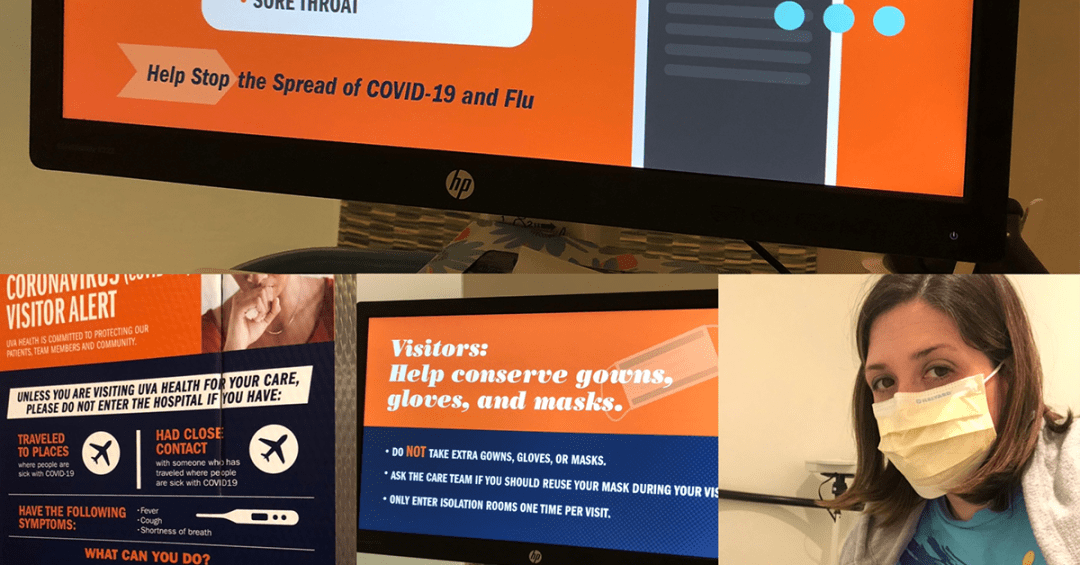 The world we spoke of last December has been transformed by the COVID-19 crisis. In our last update, we talked about airplane rides, hospital excursions, and theme park rides. Now, we wear masks to the grocery store, avoid airplanes, and enter hospitals with trepidation. The world of April’s healthcare has also been profoundly shaped by the coronavirus pandemic.
 We have not been the only one to mobilize our defenses. Both the Mayo Clinic and the University of Virginia have locked down their campuses. As the spread of the virus swept across the nation, April remained in contact with both medical teams. With one voice, the doctors at Mayo and UVA recommended moving April’s scans from Minnesota to Virginia, breaking protocol so that April could continue her treatment in the safest environment available.
 Witkowski Blog