 Is the cross plan A? It is a simple question and yet a deeply profound question. Did God always plan to die on the cross or was it simply a response to our failings? Is God’s divine plan playing out in the theatre of the cosmos or is he frantically attempting respond to our bumbling use of independence?
The theologians Gregory Boyd and John Sanders advocate for the later. John Sanders writes, “The path of the cross comes about only through God’s interactions with humans in history. Until this moment in history other routes were, perhaps open.”
Commenting on Judas’ betrayal Boyd adds,
If Judas had gone down a different path, he wouldn’t have fulfilled the prophecy of the Lord’s betrayal…perhaps no one would have betrayed Jesus, and the passages that are now read as predicting his betrayal wouldn’t be read as such.
In short, God does not control the universe and the destiny of men and women. There is no ‘blue print’ as Boyd likes to say. Rather, God is responding to our failures out of love, working as best he can through the broken vessels of humanity to accomplish good.
This view easily connects with our hearts. We very much like the thought that God loved us enough to radically change his plan for the universe. We love thinking that God changed to redeem us. But is such a thought biblical? Jesus says no.
In Mark 9:9, we read “And as they were coming down the mountain, he charged them to tell no one what they had seen, until the Son of Man had risen from the dead.” Christ did not think his death, burial and resurrection were in doubt. He was not responding to the plans of men and women.
No, he had planned to die from the beginning of time. He knew Judas would betray him. He knew he would hang on a tree and die. He knew it because he had decreed it. Three times in the gospel of Mark, Jesus foretells and prophecies his death (8:31-33;9:30-32;10:32-34).
And, we should not be surprised that God can know the future. In Isaiah 48:9-10, we read
Remember the former things of old, For I am God, and there is no other; I am God, and there is none like Me, Declaring the end from the beginning, And from ancient times things that are not yet done, Saying, ‘My counsel shall stand, And I will do all My pleasure,
We are not constantly taking away from and adding to God’s plans. Rather, we are moving within God’s ordained will.
In Revelation 13:8, we read of the “lamb slain from the foundation of the world.” Before Adam and Eve took a breathe, God knew they would sin. And even better, God had planned to rescue them and us. He had planned to send his son to pay for the sins of the world, so that Jesus might be the first of many brothers (Rom. 8:29).
And here is the great news for you and for me and for our children. God can be trusted. God is not simply bungling through life like some Greek god who has to manipulate men to get what he wants. We do not pray and call out to him hoping that God might somehow be able to overcome the odds and help us.
No, we call out to the God of the universe who rules all. What makes God so amazing is not that he makes much of us. What makes God amazing is that he redeems us to make much of him. God saves us so that we can experience the glory of the divine.
And this has always been his plan. He is not responding to us. He is doing what he always planned. “He does as he pleases with the powers of heaven and the peoples of the other.” (Dan 4:35).
Such knowledge should excite all Christians. Because God rules, we can cry out to God with confidence. As the Pastor Paul David Tripp wrote,
Your world is not a world of constant chaos controlled by impersonal forces. Your destiny is not in your hands or the hands of other people. You are held in the hands of your Father, who rules everything…Because he rules heaven and earth according to his wise plan, I need not live in anxiety and fear.
We can trust God’s promise to grow our faith. We can trust God’s promise to care for us when we get cancer and when family members hate us. We can trust his promise that sting of death has been removed. We can trust God because he rules.
There is no plan B,C,D. Yes, God reacts to us within the narrative of human history. Yet, ultimately that narrative is of his creation. He planned it, he guarantees it, and he accomplishes it. Because plan A was at work in Genesis 1, we can be sure it is at work in Revelation 1. We can trust God with all our worries and concerns. Do you believe in the cross is plan A?
 When we think of taking up a cross, we often think of Mrs. Martha saying that her recent battle with the flu is her cross. Or perhaps, we think of musicians peddling snazzy shirts and necklaces of the symbol of death. But is this what Jesus meant when he commanded us in Mark 8:34 to “take up our cross.” Is taking up our cross nothing more than patiently bearing with life’s disappointment while engaging in some Christian marketing?
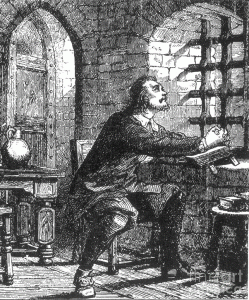 The great theologian and Pastor John Bunyan once told his church that, “I never had in all my life so great an inlet into the word of God as now: those scriptures that I saw nothing in before, are made in this place and state to shine upon me: Jesus Christ also was never more real and apparent than now; here I have seen and felt Him indeed…I have had sweet sights of the forgiveness of my sins in this place, and of my being with Jesus in another world.”
 Witkowski Blog