 Despite the worry of many Christians, Christ is still very much a part of Christmas. Secular music specials feature songs for from our church hymnals, stores decorate with nativity scenes, and Christmas cards continue to feature the Wise men on their way to view baby Jesus. In short, the battle between the culture and our churches is not really over whether or not we keep the first syllable in the word Christmas. The real fight is over the virgin birth. It is over Jesus’ identity.
Our culture has no problem praising the arrival of Jesus, the great teacher. After all, Jesus cared about the poor, offered the world of ton of pithy statements, and tried to bring peace to earth. As the atheist R. Elisabeth Cornwell remarked, “Christmas belongs to anyone who wants it, and just because I gave up believing in a god doesn’t mean I gave up believing in the love and joy of family.” In short, the world has no problem with celebrating the principles that Jesus triumphed while on earth.
The real Christmas battle is actually being fought over the virgin birth. As the great revolutionary writer Thomas Paine once wrote, “It is…at least millions to one, that the reporter of a miracle tells a lie.” Miracles are inconceivable to the modern scientific mind because they bespeak of a reckless embrace of the absurd. But what makes the virgin birth so unfathomable to the modern mind goes beyond the scientific method. The theological and the philosophical implications are truly the most troubling part of the Christmas story for our culture.
If Jesus was really born of a virgin, then his claims of divinity carry great weight. His offer of salvation transforms from a pithy idea into an ever present reality. If we belief, Jesus can down from heaven being both fully God and fully, then we truly must worship him. We must obey him. We must realize that we are powerless to redefine sexuality, morality, or to pay for our wrongs. We must surrender our lives to him. And then, we must do all that we can to follow him. As the pastor Tim Keller wrote,
If there is a God, and he has become human, why would you find it incredible that he would do miracles, pay for the sins of the world, or rise from the dead?
If we admit that something miraculous happened in that Bethlehem stable so long ago, then we have to admit that something even better happened on Calvary. We have to admit the Jesus, the “way the truth and the life.”
But what if the Paine and today’s atheists are right? What if Jesus is simply just another human? Is Christmas still worth celebrating?”
I think the answer is most decidedly no. As Paul said in I Corinthians 15:19, “If in Christ we have hope in this life only, we are of all people most to be pitied.” If Christ is not God, Christmas is not a triumph over sin and death. Rather, the holiday is a testimony to the futility of humanity. Think about it. Thousands of babies are killed because of this Jesus’s birth. He most loyal predecessors and cousin ends up dead at because of an evil king. Eventually, Jesus too is executed unjustly. And then all but one of his disciples is murdered or executed. When Jesus attempted to bring at the best in people, he was slain by the worst in people. Christmas without a divine Jesus is nothing more than a tale of human hope dashed upon the rocks of human failure. Why celebrate Jesus if he is just human?
Thankfully, Jesus life and death were not useless. He was not just a man. He was both fully man and fully God. By his death and resurrection, Jesus secured eternal for the innocent babies that died Bethlehem, for John the Baptist, for his disciples, and for the millions of his followers. Jesus conquered death. As Hebrews 2:14b-15 says,
he himself likewise partook of the same things, that through death he might destroy the one who has the power of death, that is, the devil, and deliver all those who through fear of death were subject to lifelong slavery.
As we talk about Christmas in the days ahead, let’s not just stop with putting Christ in Christmas. Let’s mention who Jesus really is. Let’s share about how the whole meaning of Christmas rides upon the virgin birth. From Bethlehem, the whole story of salvation unfolds. Are we ready to share it?
 The Christmas holidays is perhaps one of the greatest sources of hope for humanity. We gather together to eat big family meals, we exchange presents with long lost relatives, and we take an interest in the poor and broken. The very lights on the street seem to boldly proclaim that hope for humanity does exists. As Lady Gaga recently said, “Kindness is the cure to violence and hatred around world.” Is there a kinder time than Christmas for the western world? Let the hope bubble up anew.
 Tis the season of Christmas trees, little snow men, and lots of controversy. As with many holidays, Christmas brings with it a sleigh full of traditions. And every December, we Christians must spend some time unpacking them all. We must all decide whether or not an elf can sit on our shelf, whether or not a fat man can slide down our chimney, and whether or not we will stick a tree in our living room. We determine for our family which traditions bring Christ glory and which ones are really nothing more than spiritual coal. So how do we do this? How do we figure whether or not Jesus likes our traditions?
 I know this may sound simple, but it is worth repeating. As much as Christmas is designed to be a season of light, it can include many dark and disturbing traditions. Once while working at a large bookstore, I observed a woman buying a playboy calendar for her husband. As she shopped, I heard her tell her friends that she and the other ladies in her family frequently bought playboy merchandise for their significant others each Christmas. Sadly traditions like this are far too common during the holidays. As believers, we must forsake all sinful things. Paul explicitly tells us that in I Corinthians 10:14 that we are to “flee from idolatry.” We are to flee from things that will keep us from Christ. We are to flee from sexually immorality, drunkenness, and greed. Any tradition that promotes idolatry, the worship or celebration of anything other than God, must be avoided. We cannot participate in them. If a tradition leads to or promotes sin, unplug you and your family from it.
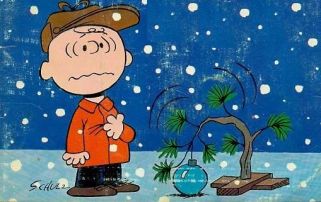
 Regardless of where we fall on traditions, our heart should always be to seek the good of our neighbors. We should always seek peace and unity when tackling the grey issues of Santa Clause, the Grinch, and the Charlie Brown Christmas special. We can both embrace and reject these traditions without sinning. But if our placement of a little red elf or the use of a tree is going to cause division in our churches, we can give them up. And if our neighbor sees nothing wrong with a tradition and is not sinning by singing Frosty the Snow Man, we can stuff our criticism back in the bag. We can simply sing along. But if someone says they teach their kids about Santa Clause to manipulate the behavior, we can address it in love. But at the end of the day, we do should not use traditions to divide ourselves from our brothers and sisters in Christ. They should bring us together. If they do not, we very well may have knowledge and no love. We may very well criticize others and tell them how right we are and all the while miss the very crux of the gospel as seen in the Christmas story. As Paul says in Romans 8:2, “If anyone imagines that he knows something, he does not yet know as he ought to know.” If we think we have a monopoly on how to best celebrate Christmas, we have missed the fact Christ came to save and redeem us from our sin. Jesus did not come to celebrate our self-righteousness. Embrace your traditions with humility.
 Witkowski Blog