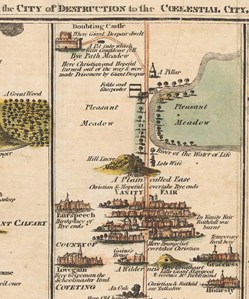
 “We are on a journey” is a phrase tossed about frequently in today’s religiously minded world. We are all said to be searching for meaning and significance. Many think their journey is an uncertain trip whose destinations rapidly changes according to the times and events of the universe.
I too enjoy employing the journey language when talking about spiritual things. But despite our language to the contrary, this journey is not one of our making. As John Bunyan shows in his beautiful allegory, Pilgrim’s Progress, God ordained that all of humanity would set forth from the City of Destruction, Vanity Fair, or some other worldly place. And God decreed that we all will arrive at one of two places: Hell or the Celestial City. As Good Will once told Christian, “Yes, there are many ways Butt down upon this: and they are Crooked and Wide; But thus thou may’st distinguish the right from wrong, That only being the straight and narrow.”
Admittedly, we can arrive at both Hell and Heaven through a variety of unique circumstances. As Bunyan wrote,
I saw that there was to Hell, even from the Gates of Heaven, as well as from the City of Destruction.
Many choose the broad way and are crushed into Hell as they search for silver in Demas’ cave. Others are ushered into Beelzebub’s kingdom as they chase after the worldly glory sold at Vanity Fair. And still others venture barely outside of the City of Destruction, like Pliable, and are consumed when the Lord returns in judgement.
But some stay on the narrow path. They get to Heaven by being burned at the stake like Faithful. Others struggle poorly through life as Little Faith did. And others walk faithfully through the waters of death like Christian and Hopeful.
Regardless of their religion, philosophy, or hopes, no man, woman, or child found another ending to their journey. Mr. Legality, Mr. Atheist, and Mr. Talkative cannot will another destination into existence. All arrived at either Hell or Heaven. All must decide if they will love this world or the one true God.
And now we must face the questions that Bunyan’s Pilgrim’s Progress seeks to answer. How do we get to the Celestial city? How do we escape the wrath to come?
The Story Begins
First, we must recognize that we are sinners. We must recognize like Christian, the Hero of the story, did that he stands in judgment. We must understand that because our sin, we deserve death and God’s wrath. As Romans 6:23 makes clear: “The wages of sin is death.”
 We must ask with Christian, “What shall I do to be saved?”
And we must realize that we do have a large burden of sin on our back that weighs us down composed of all our lies, hateful words, evil thoughts and actions. And we must recognize that we can do nothing to remove it. We cannot say enough good things to get rid of our sin. We cannot go to church enough to make God overlook our sin. Mr. Legality and World Wiseman cannot save us. We must appeal to God for salvation. And then we must flee our place of origin, our sinful nature, and put our fingers in our ears and run, crying “Life, Life, Eternal Life.”
We must embrace Christ as our Lord and Savior. To do so, we must believe as did Hopeful, one of Christian’s friends on the journey, that:
Christ Jesus came into the World to save sinners. He is the end of the Law for righteousness to everyone that believers. He died for our sins, and rose again for our justification: He loved us, and washed us from our sin in his own blood: He is the Mediator between God and us.
Paul wrote in Galatians 3:13, “Christ has redeemed us from the curse of the law, having become a curse for us (for it is written, “Cursed is everyone who hangs on a tree”).
We must realize that we are under the law, and then we must trust Christ to redeem us from the law through his death. We must believe that Jesus saves. And, we must kneel before the cross like Christian did.
And when we do, we will experience great relief. Our burden like Christian’s will fall away. Our worldly ragged clothes stained by sin will be replaced with heavenly garments.
For He made Him who knew no sin to be sin for us, that we might become the righteousness of God in Him – 2 Corinthians 5:21
The moment we believe, we are fully redeemed, saved, and children of God. Nothing and no one can separate us from God’s love.
The Story Continues
Although we are citizens of the heavenly city, our journey does not end at salvation.
When Christian was at Interpreter’s house, he watched many dramas unfold. One such drama takes place outside of a castle guarded by strong soldiers. Many people wanted to go into the castle. But no one dared challenge the guards standing by the door. Finally, “a man of a very stout countenance” came up and told the man at the gate write down his name in the book of life (p.33). And then the stout man began to fight his way through the guards who attacked him, “with deadly force” (p.33). But the man was not discouraged by the wounds he received. And he fought on into the palace and was clothed with eternal glory.
In short, Bunyan understood that the Christian life was a battle. The pilgrim’s journey was difficult one that would require divine resolve. As Bunyan wrote, all those who follow Christ will can expect to experience,
Wearisomness, Painfulness, Hunger, Perils, Nakedness, Sword, Lions, Dragons, Darkness; and in a word death
And the concerns that Mr. World-Wiseman’s mentioned to Christian become very real. As the story unfolded, Christian ran into many of these things. But what lay ahead of him was more than worthy of all of these sufferings. And Christian knew that all those who persevered would enter the Celestial City.
As Christian traveled through this life he encountered many hardships. First, he met with Apollyon, the Prince of darkness. The Devil assailed Christian with accusations of his unworthiness for the Celestial City. Apollyon brought up many of Christian’s failings and encouraged him to once again submit. But by the power of God’s grace, the pilgrim refused to bow to the Devil, knowing he had already received the “Pardon of my Prince.” And resting in God’s forgiveness, Christian fought with Apollyon for an whole afternoon. Just as the Devil was about to kill Christian, Christian regained his sword and stabbed Apollyon in the liver, mortally wounding the devil.
The pilgrim then walked into the value of the shadow of death. Bunyan said it was a land for dry souls filled with “Hobgoblins, Satyrs, and Dragons of the pit…a continual howling and yelling, as of People under unutterable misery…. and Clouds of confusion.” It was a narrow, dangerous and dark way with pits and swamps on both sides that would swallow travelers. But as Christian cried out in prayer, he found hope and was able to survive this powerful trial and stay on the path.
Then Christian and his newly met friend, Faithful, walked into Vanity Fair, which the devil had placed in the way of the narrow path. And when the pilgrims refused to exchange Jesus for the love of the world, the people of the Fair put Christian and Faithful in prison. They pilgrims were tried as criminals. Faithful was condemned to death and was burned on the stake on the testimony of many false witness. But some towns people reported seeing a chariot take him to the Celestial city. A little while later, Christian escaped by God’s mercy and continued on the joinery.
Shortly thereafter, Christian met a new friend, Hopeful. Once, they wandered off the narrow path and  were captured by Giant Despair. The massive man of darkness threw the pilgrims into prison, starved them, and beat them repeatedly. Christian began to lose all hope and thought about committing suicide. But Hopeful reminded Christian of all that they had done by God’s grace. And then, Christian remembered that he had a key called promise. As they tried the key on the castle doors, the castle doors swung open. They escaped the depression and despair of this world by clinging to the hope that all Christians have in Christ and returned to the narrow way.
The two pilgrims encountered many other trials, blessing, and wayward souls. And Christian and Faithful fought through them all like the “stout man” in Interpreters House clinging to Lord of Heaven. They received many wounds along the way from both friends and foes. But at the end of the day, Hopeful and Christian were welcomed into the Celestial City after they crossed through the river death.
As Christian’s journey comes to an end, we cannot help and begin to think of our journey and where our destination lies. Are we traveling towards the pit of Hell or the heavenly hill? As we ponder the condition of our souls, I think we should all take time to consider Bunyan’s winsome words. We should as Bunyan said,
Put by the Curtains, look within my Vail:
Turn up my Metaphors and do not fail:
There is thou sleekest them, such things to find,
As will be helpful to an honest
What helpful things can Bunyan’s book yet teach us?
PS:
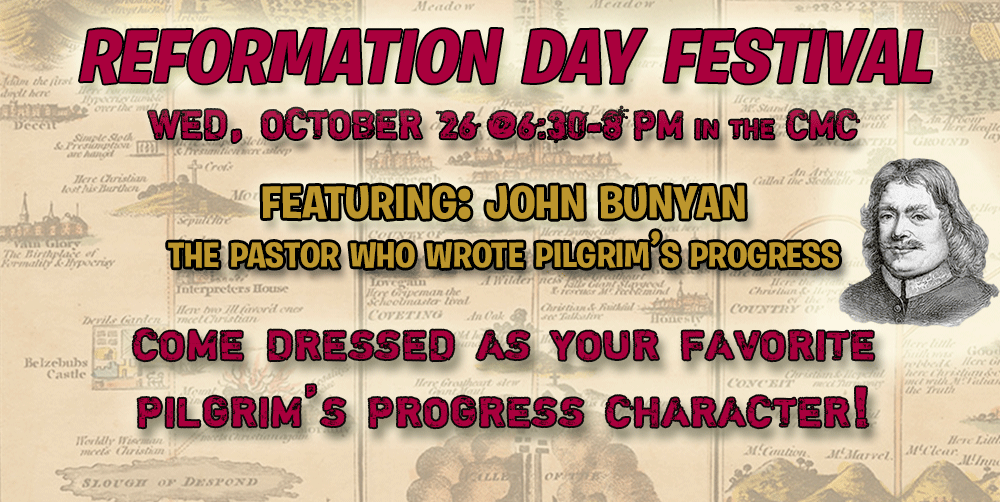
If you are interested I encourage you to read Pilgrim’s Progress. And if you live in the Eastman, GA area, I want to invite you to come experience the book first hand at our Reformation Festival on October 16, from 6:30-8PM. We will have a skit featuring John Bunyan and games that will help bring Apollyon, the Valley of the Shadow of Death, Vanity Fair, and Doubting Castle to life! I hope to see you there in your best Pilgrim’s Progress clothes!


 I was in a panic. The fire alarms were going off. My worst night mare, dying in a fire, was coming to life. Without a moment’s hesitation, I bounded out of the bed and rushed out the hotel room door determined to get down to the first floor as fast as humanly possible. But in my hurry, I forget one thing, my parents. After a few steps down the hallway, I realized my mistake and fled back to hotel room door and began pounding on it. I was in a panic.
  Witkowski Blog