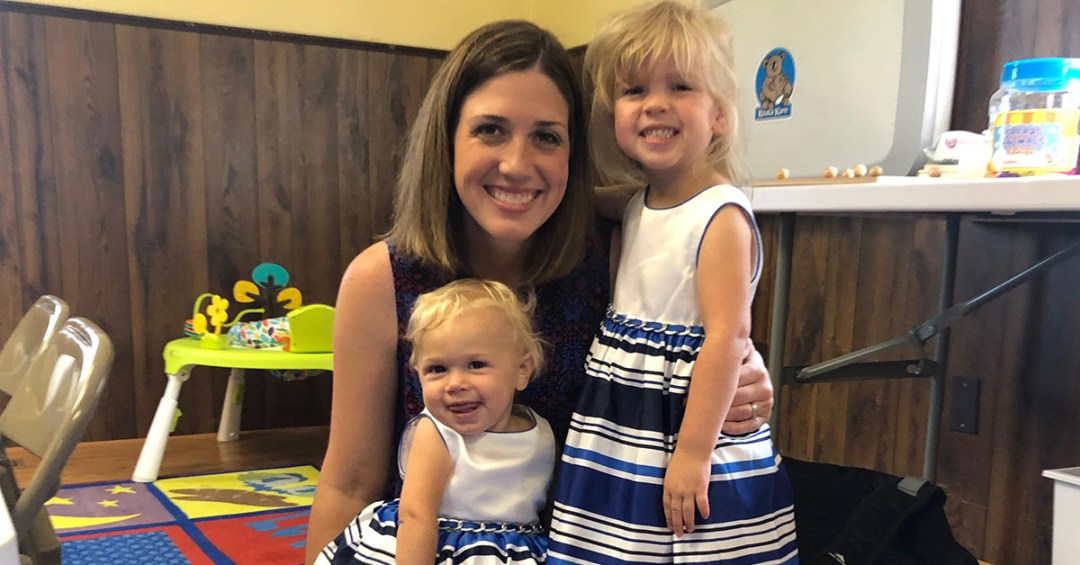
 The storm has arrived. The small, misty drops from the top of the early storm-breakers have reached our souls. The monstrous, well-formed waves of April’s cancer that threaten to capsize our life have not yet come into view. But there is no doubting the arrival of this storm in our lives.
Over the last few weeks, April’s occasional back pain has become more intense and has lasted for longer periods of times. She has felt sorrow as she weaned her baby girl and has stopping picking up our 3 year-old and 5 year-old. Over the past few days, she has also felt the first side effects of her cancer medication, fevers and bone pain. We spend our days researching drugs, calling doctors, and hunting down medical records. April’s stage four breast cancer has arrived.
After listening to several doctors, nurses, and nurse practitioners, April and I can now discuss the essential elements of this cancerous storm with some certainty. We know her tumor has existed at least since last November. At that time and on two ensuing occasions, April discussed a lump in her breast with her OGBYN. He ignored her concerns, saying he would schedule a mammogram or ultrasound for her in June if the lump still existed. April’s breast cancer has grown slowly, feeding off of estrogen and progesterone. But with that being said, we know the cancer has had time to extensively flow throughout April’s body. The cancer has metastasized, expanding from the confines of her breast to reach her lymph nodes, her blood, and her bones. The cancer could also possibly reside in her liver, but the tests are not conclusive.
The ER+ and PR+ and HER2- breast cancer is considered a more treatable and manageable form of breast cancer. Employing hormone therapy and eventually chemotherapy, doctors think the cancer’s raging waters can be held at bay and potentially pushed back into the sea of suffering from whence they came. However, the storm will eventually adapt, regain strength, and come back to our shores.
Medicine cannot cure hormone based cancer.
According to the doctors, the cancer will most likely crash into our hearts with life-taking power in 6 or 7 years. But the doctor’s expectations are little more than the law of last year’s averages. In many ways, our storm still lacks a defined shape. Until April begins her treatment and the doctors measure how her cancerous storm responds to the various therapies, we can only vaguely speak of the storm’s path, duration, and ability to cause harm. April and I hope and pray that April will be able to successfully battle the waves of this storm for the next 15 to 20+ years.
Just as communities turn to sandbags, bulldozers, and the National Guard for help as massive storms approach, we have reached out to the top breast cancer clinics in Virginia and as well as the top three breast cancer clinics in the United States. We will do all in our power to bolster April’s natural defenses. We will begin exploring treatment options and clinical trials at Mayo Clinic, Sloan-Kettering, and UVA during the next two weeks. Hopefully we will be able to share more about the location and nature of April’s treatment come early July.
When storms of this life changing magnitude slam into our lives, we invariably find our minds drifting to the “why” questions. Why did God allow April’s OGBYN to ignore her concerns about a lump in her breast? Why did God send her, me, our children, and our extended families into this storm? Why did not allow her cancer in the first place?
I honestly don’t know why. But this I do know: God is good, and God is with us! Isaiah 43:1-2 says:
But now thus says the Lord, he who created you, O Jacob, he who formed you, O Israel: “Fear not, for I have redeemed you; I have called you by name, you are mine. When you pass through the waters, I will be with you; and through the rivers, they shall not overwhelm you; when you walk through fire you shall not be burned, and the flame shall not consume you.
Isaiah spoke these words to Hezekiah. His kingdom was under attack and at the point of death. But God promised to be with his people as they suffer. April and I experienced the special presence of God when we lost our first-born-son Peter Alexander in 2013. Christ stood with us then. And we are sure that God is standing with us now because we are certain that Jesus left the tomb and reigns in heaven.
As we dive into the waves of the latest storm, we trust that God will strengthen our muscles of faith, belief, and trust. Each time we fear the waves will overwhelm us, God arrives and saves us. He has dried our many tears with the warmth of his love. And as we have begun to speculate the about a wifeless and motherless future, God’s Word has reminded us that we have nothing to fear. We are his redeemed people. No wave or fire will break us for our God stands with us amidst the storm. There is no fear to large for God. As the hymn says, “All I ever needed thy hand hath provided.”
In Mathew 8:23-27, the disciples were tossed violently by the sea. They turned to Jesus in a panic and said, “Save us, Lord; we are perishing.” Notice how Jesus responded:
And he said to them, “Why are you afraid, O you of little faith?” Then he rose and rebuked the winds and the sea, and there was a great calm.”
We are tempted to fear. But then we look and see our savior resting peacefully for he rules the waves and April’s cancer.
He is our hope. As we suffer with Christ, we find our Lord and savior to be so sweet and so good. He’s with us, he hears us, and he will deliver us! We can confidently say that the words Psalm 34:8 become true with each passing day.
Oh, taste and see that the Lord is good! Blessed is the man who takes refuge in him.
Contact Info:
We have been blessed by the love of our families, our ABC family, and our friends. If you wish to contact us, we ask you to do the following:
Email us at: biblefighter@gmail.com
You can reach us via snail-mail at : P.O. Box 637/ Amissville, VA 20106
You are also welcome two reach out to the elders of Amissville Baptist Church, Mark Hockensmith and Bill Brown, at: 540-937-6159.
Click here for our GOFundMe Page
Though April and I welcome inquirers and emails, calls, and texts of support, they can be overwhelming at times. We appreciate your patience with our responses.
We plan to also keep posting updates here at witkowskiblog.com
Thank you for your love, prayers, and never-ending support.
God is good!
Sustained By Grace Through Faith,
Peter & April
 We are all about trusting Jesus. We love to sing about how great is a our God. We nod in devoted agreement as our friend encourages us to, ‘keep believing.” And, we get squeamish when someone mentions how hard their family life is. More Faith!

 Witkowski Blog